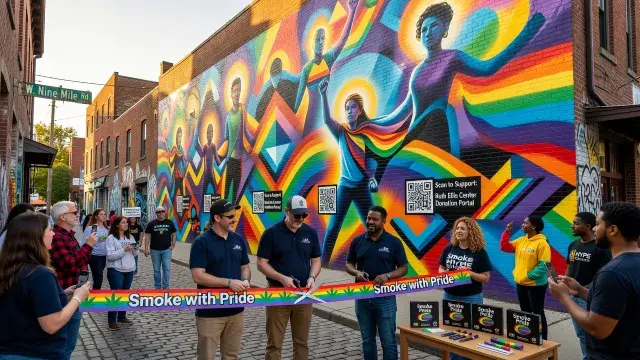
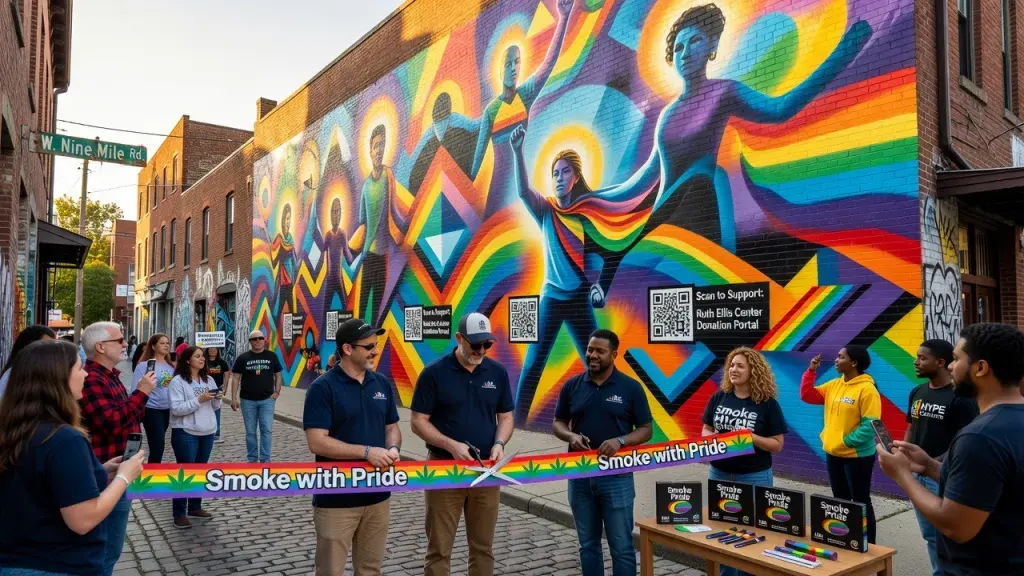
Two Michigan cannabis retailers put their marketing budgets toward something other than a discount campaign this month. JARS Cannabis and HYPE Cannabis cut the ribbon on "Polychromatic Super You," a 40-by-25-foot mural by Michigan artist Joey Salamon, installed in an alley off W. Nine Mile Rd. in downtown Ferndale. The unveiling doubles as the public face of Smoke with Pride, a joint campaign directing a share of product proceeds to Detroit's Ruth Ellis Center, which serves at-risk LGBTQ+ youth in the region.
The mechanics are worth unpacking, because this is more than a paint job. Ten percent of proceeds from HYPE products sold at JARS locations, and all proceeds from a co-branded Smoke with Pride kit, get routed to the nonprofit - a structure that requires clean SKU-level tracking to separate donation-linked sales from the rest of a dispensary's menu. That's not trivial. Retailers running promotional giveback programs need point-of-sale systems capable of isolating specific product lines for accounting and reporting purposes, distinct from the seed-to-sale compliance data operators already feed into state traceability systems. Operators managing multi-state footprints know this problem well; a dispensary in Illinois running a similar cause-marketing tie-in would lean on a cannabis point of system illinois setup built to flag charitable-proceeds SKUs without disrupting excise tax calculations or muddying inventory shrinkage reports. cannabis point of system illinois
Why Retailers Are Investing in Local Art and Cause Marketing
Cannabis companies operate under advertising restrictions that alcohol and most consumer brands don't face - no billboards near schools, no imagery that appeals to minors, limits on where and how products can be promoted at all. Public art occupies a gray zone that's proven attractive: it's visible, it's shareable, and it doesn't require the same regulatory sign-off as a traditional ad buy. A mural commissioned by a licensed retailer still has to steer clear of depicting consumption or making health claims, but it can carry a brand association and a charitable message without tripping the same wires as a dispensary storefront sign or a social post pushing a sale.
The QR code attached to the mural is a small but telling detail. It routes foot traffic - tourists, Ferndale residents, anyone walking the alley - to information about the Ruth Ellis Center and a donation portal, not to a JARS or HYPE product page. That distinction matters for a regulated industry trying to build community goodwill without appearing to convert a public safety or cultural cause into a sales funnel.
The Business Case Behind Cannabis and LGBTQ+ Partnerships
JARS Marketing Director Stefanie Michels framed the project around a historical link between cannabis culture and LGBTQ+ activism, and that framing isn't incidental. Cannabis operators, still shut out of federal banking protections and taxed under 280E regardless of state legality, have leaned on identity-driven marketing and community partnerships to differentiate in crowded adult-use markets where wholesale pricing keeps compressing. Aligning with a cause like the Ruth Ellis Center offers reputational value that a straightforward discount promotion doesn't, particularly in a state like Michigan where license counts have grown fast enough to make brand loyalty, not price alone, the thing that keeps customers walking back into a specific storefront.
None of this changes the underlying compliance reality. Every transaction tied to the campaign still has to clear age verification, compliant packaging rules, and lab testing requirements before it reaches a counter. Cause marketing doesn't loosen consumer protection standards - it sits on top of them. For operators watching this campaign from other markets, the lesson isn't the mural itself; it's the back-end work of tracking donation-linked sales cleanly enough to report them honestly to both regulators and the nonprofit on the receiving end.