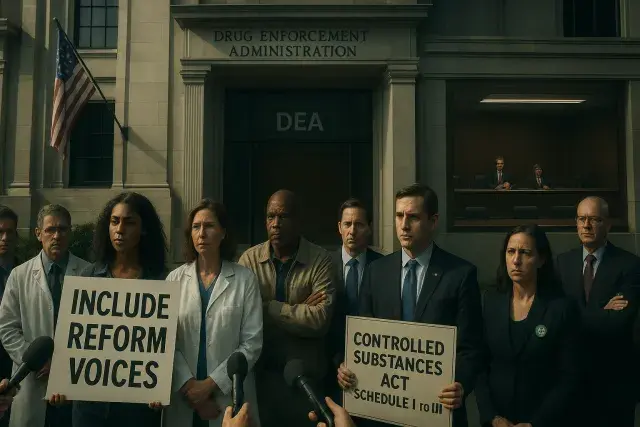
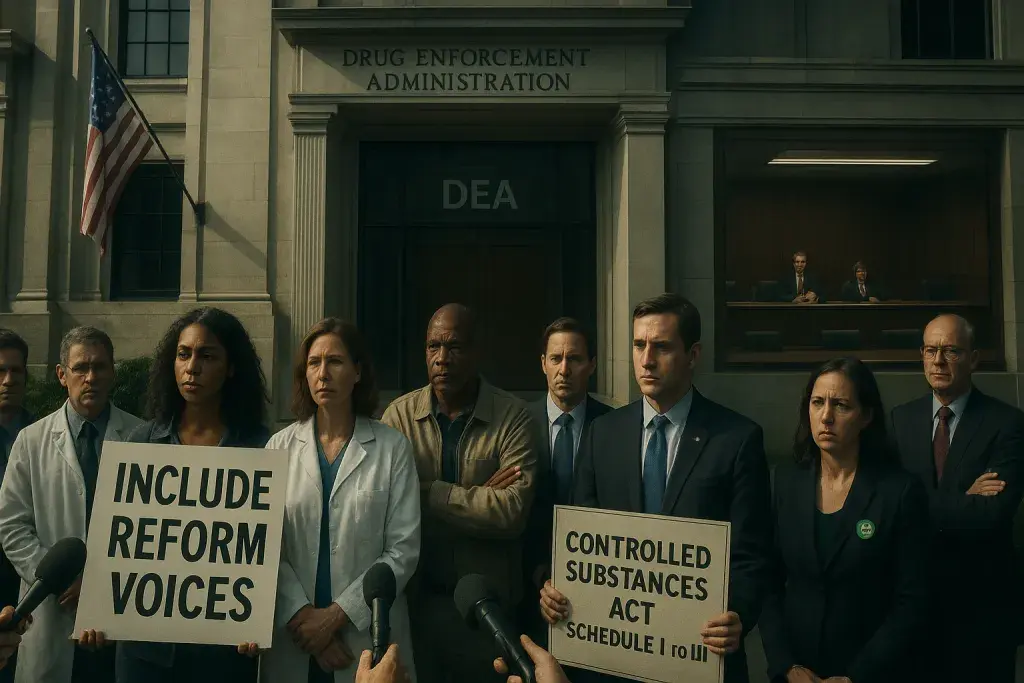
A formal administrative hearing on whether to move marijuana from Schedule I to Schedule III of the Controlled Substances Act opened this week at Drug Enforcement Administration headquarters - and the people with the most at stake weren't allowed inside. Legalization advocates, medical professionals, former federal prisoners, and licensed cannabis operators who requested to participate were denied. The DEA selected only opponents of marijuana reform as designated hearing participants, leaving the agency itself as the sole voice arguing for the rescheduling proposal it is simultaneously adjudicating.
For dispensary operators already managing the business pressures of a federally complicated market - from 280E tax exposure to cash-heavy operations and state-by-state compliance requirements - the hearing's structure raises a pointed question about how durable any resulting federal policy shift will actually be. Operators in markets like New Jersey, where regulatory demands touch everything from seed-to-sale tracking to point-of-sale for New Jersey dispensaries, have been watching the federal rescheduling process closely because the outcome shapes everything from tax treatment to banking access. A process that excludes reform advocates from the record doesn't inspire confidence that the outcome will hold up to legal scrutiny.
The DEA's justification for excluding pro-reform voices is, charitably, technical. The agency argues that supporters of rescheduling are not "adversely affected or aggrieved" by the proposed rule - the standard threshold for qualifying as an "interested person" under federal administrative law. The agency itself is serving as the proponent of the Schedule III proposal. In practice, though, that arrangement means a federal agency with a documented history of opposing cannabis reform is now being asked to credibly advocate for it, while the scientific community, patient advocates, legal operators, and reform organizations who pushed for this change for decades watch from a sidewalk press conference. That's not a subtle irony. That's a structural problem.
Transparency Promised, Transparency Withheld
The DEA's refusal to livestream the proceedings compounds the access problem. When pressed - by a publication, a congressman, and legal counsel for affected parties - the agency confirmed that the hearing will not be televised, livestreamed, or broadcast in any form. The stated rationale: a transcript will be published on DEA.gov after the proceedings conclude. A post-facto transcript is not transparency. It is documentation. There is a meaningful difference between the two, especially in an administrative proceeding whose outcome will reshape federal drug scheduling for the first time in decades.
Rep. Steve Cohen (D-TN) noted that as recently as late 2024, DEA itself permitted livestreaming of a comparable hearing, citing public interest and its own commitment to a transparent process. That prior hearing was ultimately canceled amid litigation and accusations of improper coordination between DEA and anti-reform witnesses - the exact dynamic critics say is repeating itself now. The agency's credibility on transparency, in other words, is not in a strong position.
What the Rescheduling Stakes Actually Mean for Licensed Operators
Strip away the process grievances for a moment and the underlying business implications are substantial. Acting Attorney General Todd Blanche's April order already reclassified state-licensed medical cannabis and FDA-approved marijuana products from Schedule I to Schedule III - an action now producing real downstream effects across the regulated cannabis industry.
The most immediate impact for licensed businesses is the 280E question. Under current IRS code, cannabis companies cannot deduct ordinary business expenses because marijuana sits on Schedule I - a rule that has squeezed margins across every operator segment, from single-license independent dispensaries to multi-state operators running vertically integrated supply chains. Schedule III substances fall outside 280E's reach. The IRS and Treasury have confirmed they plan to issue new guidance, which means tax relief for state-licensed businesses may be closer than it has been at any point since the modern cannabis industry began. That is not a small shift for operators whose effective tax rates have long outpaced comparable businesses in conventional retail.
Beyond taxes, the Congressional Research Service has noted that certified medical cannabis patients who possess marijuana from state-licensed dispensaries now carry certain Schedule III protections. The Bureau of Alcohol, Tobacco, Firearms and Explosives updated its gun purchase form language to distinguish recreational from medical cannabis use at the federal level. The Department of Transportation, however, clarified that medical cannabis use remains disqualifying for safety-sensitive transportation workers regardless of rescheduling - a reminder that federal agency responses to this change are not uniform, and compliance teams at any operator with a delivery fleet or logistics component need to stay current.
A Process Under Legal Siege
The current rescheduling proceeding faces active litigation on multiple fronts. Lawsuits filed by state attorneys general, opponents of legalization, and a cannabis-focused biopharmaceutical company have been consolidated by a federal appeals court. A congressional committee recently voted to block further federal steps toward rescheduling, though bipartisan members have indicated that provision is unlikely to become law in its current form.
What licensed operators and their compliance and legal teams should understand is that the administrative record being built inside this hearing - a record that excludes pro-reform voices - may itself become a vulnerability in any future legal challenge to the Schedule III designation. Administrative law proceedings derive their legitimacy in part from the breadth and quality of the record. A hearing designed to foreclose one side of a scientific and policy debate is a hearing that invites judicial scrutiny. The hearing is scheduled to conclude no later than July 15. Whatever comes out of that room will face pressure from multiple directions, and no operator should plan long-term financial or compliance strategy around a result that is not yet legally settled.
The cannabis industry has spent years building compliance infrastructure - state licensing systems, seed-to-sale tracking, lab-tested inventory, compliant packaging - on the assumption that federal alignment was eventually coming. The rescheduling process is the closest thing to that alignment the industry has seen. The fact that it is unfolding inside a courtroom where only one side of the argument is represented should concern everyone whose business depends on it landing on solid legal ground.