Cannabis delivery has always carried a compliance burden that storefront retail doesn't face in quite the same way. A product leaves a licensed facility, travels on public roads, and lands in someone's hands off-premises - every step of that chain needs a record. Software built specifically for dispensary operations is now treating each stage of a delivery as a distinct checkpoint rather than a single transaction, and that shift matters more than it might first appear.
Why unresolved matches shouldn't move quietly
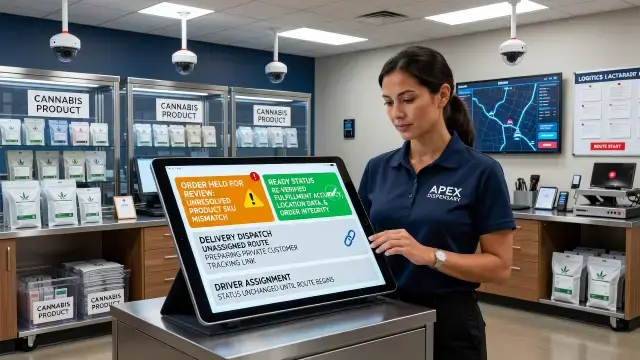
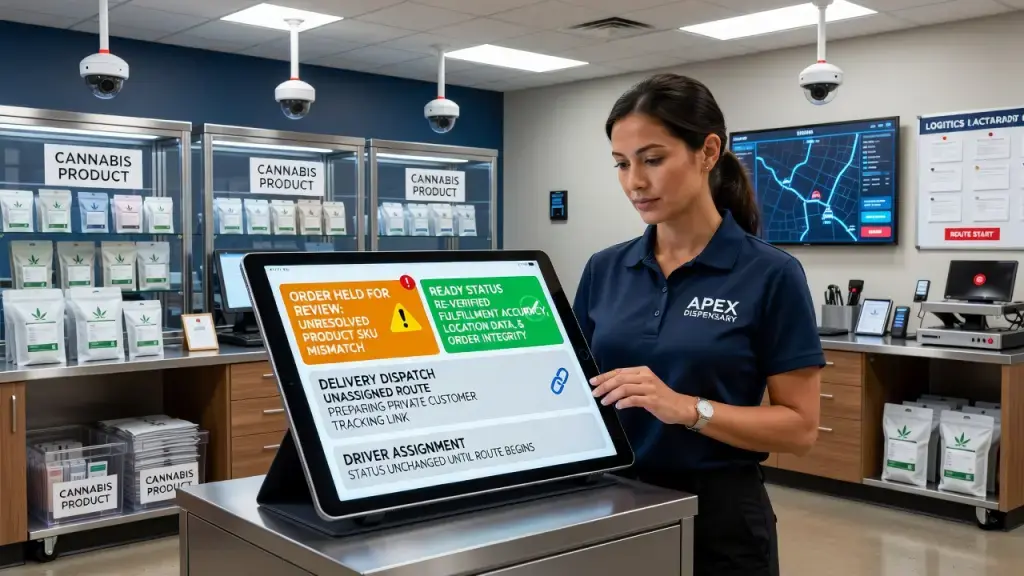
An order enters a store's workspace, and if a product match is unresolved, it gets held for review instead of advancing. That sounds like a minor technical detail. It isn't. Mismatched SKUs, substituted batches, or unverified product-to-order pairings are exactly the kind of thing that turns into a compliance log entry nobody wants to explain later. Holding the order for manual review before it reaches packing is a defensive posture - it assumes error is possible and builds a stop into the workflow rather than trusting the system to sort itself out.
Ready as a checkpoint, not a formality
Marking an order "Ready" sounds procedural until you consider what's actually being rechecked: fulfillment accuracy, location data, and order integrity, all validated again before the order can move to dispatch. In a regulated retail environment, that kind of layered verification is the difference between a clean delivery manifest and a discrepancy that surfaces during an audit. Packing lines get checked by staff; the system checks them again. Redundancy here isn't inefficiency - it's the point.
Dispatch, assignment, and the problem of visibility
Once an order is Ready, it becomes unassigned work inside Delivery Dispatch, and a private tracking link gets prepared for the customer. Assigning that stop to a driver puts the route in their app, but - and this is a distinction worth sitting with - assignment alone doesn't change the order's status in Order Hub. It stays Ready until the driver actually starts the route, at which point every order tied to that route shifts to Out for delivery automatically.
That gap between "assigned" and "in motion" isn't a technical quirk. It reflects a real operational truth: a driver with a route loaded hasn't necessarily left the lot. For dispensary managers juggling same-day changes, knowing the difference between assigned and departed is what keeps a delivery day from becoming guesswork.
Proof of delivery and the compliance record it leaves behind
Delivery tracking pages that show order stage, delivery window, and ETA serve a dual purpose. Customers get visibility into where their order stands, which reduces the call volume stores otherwise absorb. But the same data - timestamps, stage changes, driver assignment - forms part of the operational record a licensed retailer may need to produce if a regulator asks how an order moved from facility to doorstep.
Capturing a signature or photo at the point of handoff closes that loop. Which proof method a store chooses - photo or signature - is a judgment call tied to local delivery rules and age-verification practices, not a cosmetic preference. Either way, the confirmation routes back through Dispatch and Order Hub, giving the store a complete record rather than a gap between "out for delivery" and "done."
- Unresolved product matches are held, not auto-advanced, reducing the risk of fulfillment errors reaching a customer.
- The Ready status triggers a second system check on fulfillment, location, and order integrity.
- Order status only moves to Out for delivery when a driver begins the route - not at assignment.
- Tracking links give customers visibility while preserving a record retailers may need for compliance purposes.
- Photo or signature proof at delivery supports age-verification and accountability at the point of handoff.
None of this changes the underlying reality of cannabis delivery: it remains a regulated activity with age restrictions, packaging requirements, and jurisdiction-specific rules that vary from one market to the next. What tools like this address is the operational discipline around that reality - making sure every stop in the process is checked, logged, and visible, so a dispensary's delivery program holds up to scrutiny as well as it holds up to a busy Friday night.