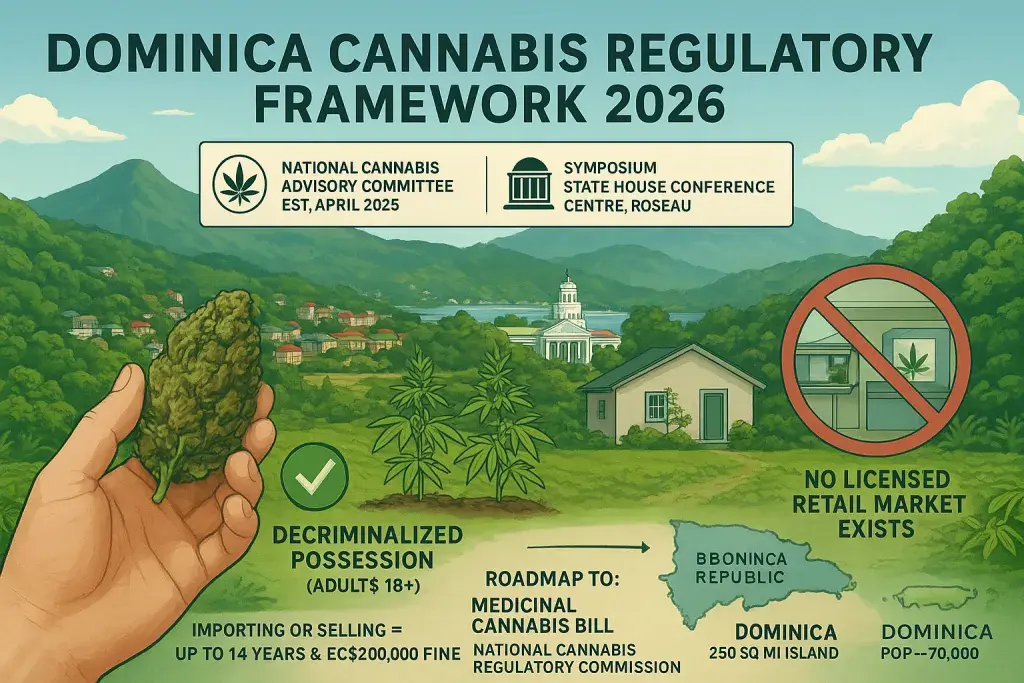
The Commonwealth of Dominica decriminalized personal cannabis possession in October 2020 and has since moved faster than most of its Eastern Caribbean neighbors toward a formal regulatory structure - but visitors and industry observers should understand one thing clearly: no licensed retail market exists, and the infrastructure to support one is still being built. What Dominica offers in 2026 is a decriminalization framework, an active government advisory process, and a reform trajectory that matters for anyone watching licensed cannabis markets develop across small-island jurisdictions.
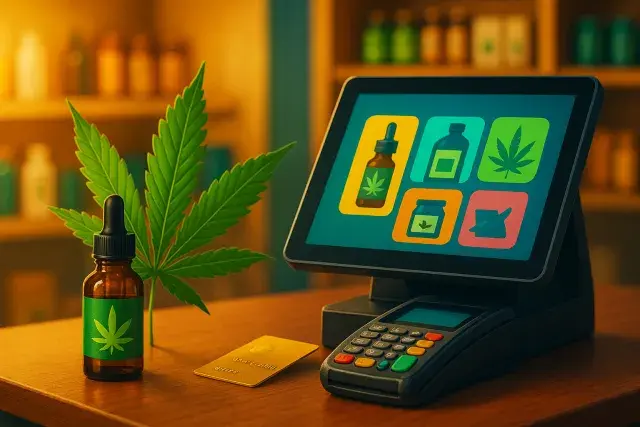
The comparison to more mature regulated markets is instructive here. In jurisdictions where adult-use retail is fully operational, the compliance burden on operators is substantial - tracking every transaction through seed-to-sale systems, managing age verification, and running a pos system for dispensary california-style operational stack that integrates inventory, compliance reporting, and cashless payments under one roof. Dominica is not there yet. Its National Cannabis Advisory Committee, established in April 2025, is working through the foundational questions - licensing structure, distribution rules, regulatory oversight - that jurisdictions like California spent years sorting out before the first legal dispensary opened.
That context matters for any business or investor paying attention to emerging Caribbean cannabis markets. The reform work happening in Roseau is real and documented. It is also early-stage, and anyone assuming a licensed retail environment will materialize on a short timeline should read the official signals carefully: government materials describe the medicinal cannabis framework as under development, not operational.
What the 2020 Law Actually Does - and Does Not - Cover
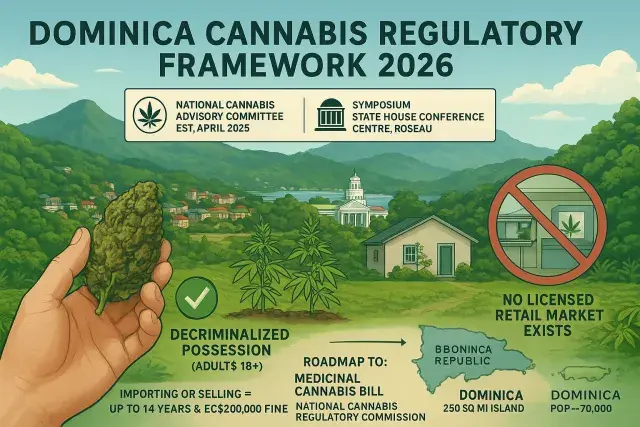
Dominica's parliament amended the Drugs (Prevention of Misuse) Act on October 26, 2020, creating a limited but meaningful decriminalization zone. Adults 18 and older may possess up to 28 grams without criminal exposure. The same adults may cultivate up to three cannabis plants at a permanent residence - a provision that acknowledged small-scale growing already embedded in Dominican agricultural life, not a right extended to visiting tourists or short-term renters.
The retroactive element of the law deserves mention. Prior convictions for possession of 28.35 grams or less were treated as spent convictions under the 2020 amendment, a direct acknowledgment of how decades of enforcement fell disproportionately on rural and working-class communities. That provision does not apply to persons under 18.
Here is where it gets operationally important for visitors: decriminalization protects possession on the island. It does not protect the act of bringing cannabis into the country. Importing cannabis into Dominica is a criminal offense carrying penalties up to 14 years' imprisonment and EC$200,000 in fines - approximately USD $74,000 at current exchange rates. The seller in any unlicensed transaction faces criminal supply charges regardless of how small the quantity involved. Travelers who understand the possession threshold but miss the supply-chain reality are the ones who run into avoidable legal problems.
- Possession up to 28g (adults 18+): decriminalized
- Home cultivation of up to 3 plants at permanent residence (adults 18+): decriminalized
- Purchasing from a licensed retailer: no licensed market exists
- Selling or supplying cannabis: criminal offense, up to 14 years and EC$200,000
- Importing cannabis into Dominica: criminal offense, same maximum penalties
- CBD traveler policy: no clearly published official threshold; do not assume foreign standards apply
The 2025 Regulatory Push and What It Signals for Industry
The institutional steps Dominica took in 2025 moved the country from policy conversation to framework construction. The National Cannabis Advisory Committee launched formally on April 2, 2025, with a mandate covering legislative review, regulatory design, and a roadmap for a licensed industry that would include small-scale traditional cultivators - not only large commercial operators. In July 2025, Dominica hosted a National Cannabis Symposium at the State House Conference Centre in Roseau, a two-day event focused on the regulatory and economic requirements for a viable medicinal cannabis industry. Regional experts, policymakers, legal advocates, and grassroots organizations participated.
The Advisory Committee is expected to recommend the creation of a National Cannabis Regulatory Commission, and government communications indicate active work toward a Medicinal Cannabis Bill and a formal licensing framework. No launch date for a licensed market has been announced. The honest read: Dominica is building the compliance architecture before opening commercial access, which is the right sequence - but it means the retail layer is still absent.
For operators and investors watching the Eastern Caribbean, Dominica's approach has a distinct character. The government has framed its cannabis industry goals around ecotourism alignment, agricultural self-determination, and international medicinal market positioning. That is a different value proposition than the high-volume adult-use retail model that defines markets like California or Colorado. Small-island medicinal licensing frameworks tend to prioritize export-oriented cultivation and quality control over domestic retail density - a model with different compliance requirements, different capital structures, and different risks than a dispensary-heavy consumer market.
One Geography Error That Causes Real Problems
The Commonwealth of Dominica and the Dominican Republic are two entirely separate nations. They share nothing beyond a partial similarity in name. Dominica - pronounced "dom-in-EE-ka" - is a 290-square-mile volcanic island between Guadeloupe and Martinique, with a population of roughly 70,000 people, governed from Roseau. The Dominican Republic occupies the eastern portion of Hispaniola with a population exceeding 11 million; cannabis is strictly illegal there under Law 50-88, with criminal penalties for possession, use, cultivation, and distribution.
This distinction is not a footnote. Travelers, journalists, and policy analysts regularly conflate the two, and the legal consequences of acting on misinformation in either direction are serious. If your travel involves Punta Cana or Santo Domingo, this article covers the wrong country entirely. Dominica - the Nature Isle - operates under a materially different legal framework and a reform story that stands on its own.
The bottom line for 2026: Dominica is building something, and it is building it deliberately. The decriminalization framework is real, the possession threshold is clearly defined, and the institutional momentum toward a licensed medicinal industry is documented. What does not yet exist is a regulated retail market. For industry watchers, that gap between political will and operational infrastructure is the defining story - and one that is likely to close faster than it has in most comparable small-island jurisdictions.