The comparison sounds unlikely at first: a nearly 190-year-old consumer staples giant sitting next to a cannabis multi-state operator that still trades over-the-counter. But Green Thumb Industries has been quietly executing a brand-building strategy that mirrors the Procter & Gamble model more closely than most cannabis operators would care to admit - or are positioned to replicate. For dispensary owners, wholesale buyers, and investors watching the cannabis sector mature, understanding how Green Thumb has structured its business offers a clearer picture of where durable competitive advantage in this industry actually comes from.
Portfolio Brands Instead of Commodity Cannabis
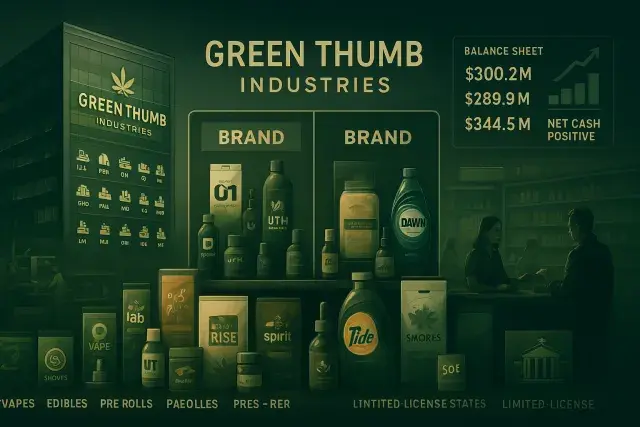
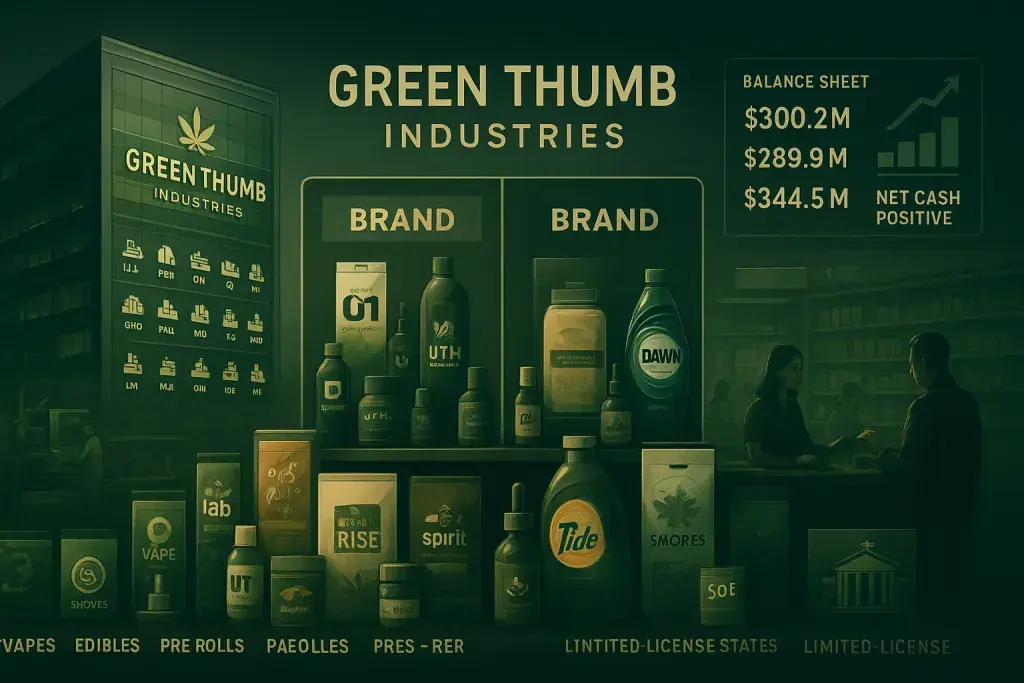
Most cannabis operators still compete primarily on wholesale price. That's a difficult position - one that tends to compress margins, erode retailer relationships, and leave brands invisible to the end consumer standing at the budtender counter. Green Thumb has taken a different approach: building a diversified portfolio of consumer brands that target distinct market segments and price points, spanning vapes, edibles, pre-rolls, and medical-grade products.
This is the P&G playbook applied to regulated cannabis. P&G doesn't sell generic soap. It sells Tide to one household and Dawn to another - same parent company, different consumer promise. Green Thumb's brand segmentation is designed to do the same thing: capture loyalty at the product level rather than competing purely on wholesale menus and SKU pricing. That distinction matters enormously in retail. A dispensary stocking a recognizable branded product with consistent repeat demand is a different commercial relationship than one filling shelf space with interchangeable bulk flower.
Standardized Production Across 20 Manufacturing Hubs
Here's the operational reality that makes or breaks brand-building in cannabis: product consistency. The industry has a long, well-documented problem with agricultural variability - batch-to-batch potency swings, inconsistent flavor profiles, erratic extraction yields. A consumer who buys a vape cartridge in one market and gets a meaningfully different experience from the same SKU in another state isn't building brand loyalty. They're learning not to trust the label.
Green Thumb operates 20 manufacturing facilities across 14 U.S. markets, and the deliberate investment in scaled, standardized production infrastructure is what makes its brand architecture functional rather than aspirational. Consistent formulations, predictable potencies, and reliable product performance across multi-state operations are not marketing claims - they're the operational foundation required to deliver on any brand promise at all. This is what P&G understood decades ago about repeatable product performance, and it's what separates a cannabis company building a true consumer brand from one simply affixing a logo to inconsistent batches.
For dispensary operators evaluating wholesale relationships, that production consistency has direct implications for inventory management, customer satisfaction, and the volume of product complaints landing at the point of sale. A reliable manufacturer reduces operational friction in the budroom and supports the kind of confident product recommendation budtenders can actually make.
Financial Discipline in a Sector That Rewarded Recklessness
The multi-state operator expansion era was not, in retrospect, a model of capital discipline. Many MSOs took on high-interest debt to race into new markets, built out retail footprints faster than revenues could support them, and ran into serious balance sheet trouble when state-level growth slowed and federal banking access remained constrained. The combination of 280E tax exposure - which for years prevented cannabis companies from deducting standard business expenses - and aggressive debt loads made profitability a remote outcome for many operators.
Green Thumb has behaved differently. In its most recent reported quarter, the company posted revenue of $300.2 million, a 7.4% year-over-year increase, with earnings per share of $0.07, up from $0.04. More telling: the company holds $289.9 million in total debt against $344.5 million in cash and equivalents - meaning it is net cash positive. Among large pure-play cannabis operators, that balance sheet posture is uncommon. Compared to Curaleaf, Cresco Labs, and Trulieve, Green Thumb carries a superior debt-to-equity ratio and lower long-term debt obligations.
That financial discipline is not incidental. It reflects a deliberate approach to market selection - specifically, a focus on limited-license states like Illinois, Pennsylvania, Ohio, and Maryland, where regulatory caps on the number of licensed operators preserve pricing power and reduce the margin compression that comes with oversaturated markets. Securing retail and manufacturing positions in license-capped states functions as a structural competitive advantage, not unlike holding prime shelf placement in a category where only a few vendors get allocated space.
The Comparison Has Real Limits - And One Incoming Catalyst
To put it plainly: Green Thumb is not Procter & Gamble, and the gap isn't purely one of scale. P&G accesses cheap institutional capital, moves product freely across state lines, and has raised its dividend for 70 consecutive years - a record that places it among the rarest class of Dividend Kings with a yield approaching 3%. Green Thumb pays no dividend. Its shares trade on the OTC market, not a major exchange, which limits institutional participation and depresses liquidity. And until very recently, the company operated under the full weight of IRS Section 280E, which denied standard business expense deductions to cannabis companies - a tax burden with no equivalent in consumer staples.
The structural difference that shapes everything else is federal illegality. Interstate commerce in cannabis remains prohibited, which means no national distribution, no shared manufacturing economics across state lines, and no access to conventional banking and capital markets on standard terms. A consumer goods company that had to build a separate supply chain for every state it sold into would look very different from P&G as well.
What changes the calculus - potentially - is the U.S. federal reclassification of cannabis from Schedule I to Schedule III. That reclassification, if it proceeds through the regulatory process, would eliminate 280E exposure for cannabis businesses, materially improving their net income without a single additional dollar of revenue. For a company like Green Thumb that is already operationally profitable and sitting on net-positive cash, the tax relief from Schedule III rescheduling would land on a balance sheet already built to absorb and benefit from it. The companies that overspent, over-leveraged, and deferred profitability may find that catalyst arrives too late to repair the underlying structure.
That's the real lesson in the P&G comparison - not that Green Thumb will become a consumer staples giant, but that the operators who treated financial fundamentals seriously from the start are the ones positioned to benefit when the regulatory environment finally begins to normalize.