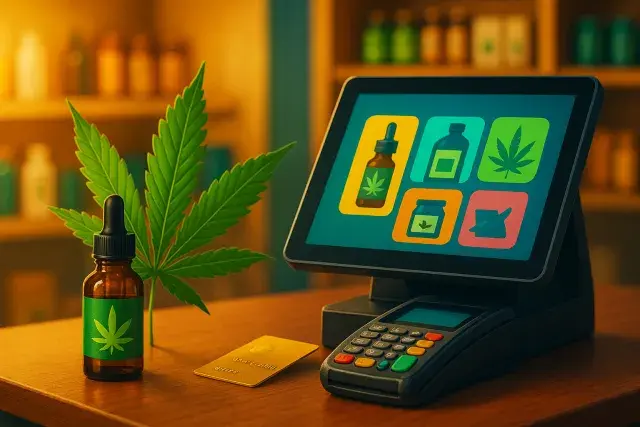

Running a CBD retail shop without the right technology isn't just inconvenient - it actively costs you money, compliance standing, and customers. The hemp industry sits at a unique intersection of strict regulatory oversight and mainstream consumer demand, which means the software managing your transactions needs to do far more than ring up sales. A standard retail POS simply wasn't built for this environment.
Most hemp retailers discover this the hard way: a general-purpose system that works flawlessly for a clothing boutique can fail completely when processing hemp product checkout, managing age-restricted inventory, or generating the compliance reports a state inspector might request on short notice. Choosing the right pos cbd solution requires understanding what makes this retail category genuinely different - and what technical capabilities separate a functional system from one that creates more problems than it solves.
This guide walks through every dimension of that decision: from hardware suited to your cbd retail display setup, to payment processing options that account for the industry's banking challenges, to the inventory and compliance features that keep auditors satisfied. Whether you're opening your first hemp store or upgrading from a system that's no longer keeping pace, the goal is to give you a clear framework for making a well-informed choice.
Understanding What Makes a CBD Point of Sale Different
The Regulatory Layer That Changes Everything
Hemp retail operates under a patchwork of federal guidance and state-level rules that vary significantly by jurisdiction. The 2018 Farm Bill legalized hemp-derived CBD at the federal level, but state agencies maintain their own licensing requirements, product labeling standards, and age verification mandates. A cbd point of sale system must be capable of enforcing these rules at the transaction level - not just tracking them in a spreadsheet after the fact.
This means your POS should support configurable compliance prompts: age verification gates before certain product categories can be rung up, automatic flags for products whose certificates of analysis are expired, and reporting exports formatted to meet state audit requirements. Systems designed for general retail don't include these features because they don't need to. Systems built specifically for cannabis and hemp do.
How Hemp Retail Differs from General Cannabis Dispensaries
It's worth distinguishing hemp retail from medical or adult-use cannabis dispensaries, because the two categories have different operational needs despite some surface-level similarities. Dispensaries typically operate in tightly regulated seed-to-sale tracking environments with direct integrations into state systems like Metrc or BioTrackTHC. Hemp retailers selling CBD products are generally not subject to the same seed-to-sale mandates, but they do face their own inventory and labeling requirements.
A cannabis pos system designed for dispensaries may offer more compliance overhead than a hemp retailer actually needs - and may lack features suited to a retail store format, such as multi-department inventory, customer loyalty programs, or e-commerce integrations. Choosing a system calibrated to your actual business type, rather than the broadest possible cannabis category, will result in a better operational fit.
Why Off-the-Shelf POS Systems Fall Short
Standard POS platforms like those used in grocery or specialty retail aren't equipped to handle hemp product checkout in any meaningful compliance sense. They process a transaction - but they don't know whether the customer has been age-verified, whether the product was legally sourced, or whether the sale generates a reportable event under your state's rules. For a hemp retailer, this gap isn't a minor inconvenience. It's a liability.
Beyond compliance, general systems often lack the inventory categories needed for CBD products: unit types like milligrams of cannabinoid content, batch tracking for COA management, or product flags for THC threshold compliance. Building workarounds inside a generic system is possible, but it creates fragility. One software update from the vendor can break your workaround entirely.
Evaluating CBD Payment Processing Options
Why Payment Processing Is a Genuine Challenge in This Industry
Hemp-derived CBD is federally legal, but many traditional payment processors and banks still treat it as a high-risk category. This stems partly from the reputational risk financial institutions associate with the broader cannabis industry, and partly from ongoing ambiguity in how individual state laws interact with federal guidance. The result is that some processors decline accounts outright, others impose elevated transaction fees, and a few terminate accounts retroactively when they identify CBD sales in transaction histories.
For hemp retailers, this means cbd payment processing requires deliberate research - not just signing up with whatever processor your POS vendor defaults to. You need a processor that explicitly accepts hemp merchants, understands the product category, and won't shut down your account during the holiday rush because an automated compliance review flagged "cannabis" in your product descriptions.
High-Risk Processors vs. CBD-Specialized Solutions
Two categories of processors are realistically available to hemp retailers. High-risk merchant account providers service a wide range of industries that traditional banks avoid - firearms, nutraceuticals, adult content, and cannabis among them. These processors will generally approve hemp accounts, but their fee structures reflect the risk premium they charge: expect higher per-transaction rates and potential reserve requirements where a percentage of revenue is held back for a period of time.
CBD-specialized processors, by contrast, are built specifically for the hemp and cannabis-adjacent market. They understand product terminology, are familiar with COA documentation, and typically offer more predictable fee structures for hemp businesses. Some are integrated directly into cannabis and hemp-focused POS platforms, which simplifies reconciliation and reduces the risk of processing and inventory data falling out of sync.
Cash Management and Alternative Payment Methods
Despite the expansion of digital payment options, a meaningful portion of CBD retail transactions still occur in cash - either by customer preference or because certain locations have limited processing infrastructure. A POS system serving a hemp retailer should handle cash management competently: accurate drawer reconciliation, shift-end reports, and clear audit trails for every cash transaction.
Emerging alternatives worth evaluating include ACH-based payment systems and PIN debit processing, both of which operate outside the credit card network and may face fewer restrictions for hemp merchants. Some retailers also implement loyalty-linked payment programs through their POS, which can reduce processing costs while improving repeat customer retention. The right combination depends on your customer base and average transaction size.
CBD Retail Display and Physical Store Integration
Connecting Your Display Layout to Your Inventory System
A well-organized cbd retail display does more than look professional - it drives purchase decisions and affects how efficiently your staff can process transactions. The connection between physical display and POS software is often underestimated. When products are logically mapped in your system to mirror their physical location in the store, staff can locate items quickly, answer customer questions accurately, and identify stock shortages before they become visible gaps on the shelf.
POS systems that support location-based inventory mapping allow you to tag products by display case, shelf, or store zone. This makes cycle counting faster and reduces the chance that a product flagged as in-stock in the system is actually sitting in the back room rather than on the floor. For CBD retail specifically - where customers often ask detailed questions about product format, concentration, and origin - having accurate, location-aware inventory data at the point of sale genuinely improves the customer experience.
Hardware Considerations for Hemp Retail Environments
The physical hardware of your POS setup should match the format of your store. A small boutique CBD shop might operate effectively with a compact tablet-based terminal and a single receipt printer. A larger hemp retail space with multiple product categories - oils, topicals, edibles, pet products - may need a full counter-mounted terminal, a customer-facing display screen, a barcode scanner, and integrated scale capabilities if products are sold by weight.
Customer-facing displays deserve particular attention in CBD retail environments, where transparency about product information builds trust. A screen that shows the customer the item name, price, cannabinoid content, and applicable discounts in real time reduces questions at checkout and supports a more confident buying decision. Some POS platforms allow these displays to show promotional content between transactions, creating a secondary marketing channel without additional hardware cost.
Multi-Location and E-Commerce Sync Capabilities
Hemp retailers who operate more than one physical location, or who sell through an online channel, need a POS that handles inventory synchronization across all points of sale. Selling the same product online and in-store without unified inventory data leads to overselling, backorders, and customer frustration. The right system maintains a single inventory record that updates across all channels in real time.
E-commerce integration is increasingly important for hemp brands because online sales - while subject to their own shipping regulations - extend reach beyond the local customer base. Look for POS platforms that integrate natively with major e-commerce frameworks or offer API connections to popular hemp-friendly online storefronts. The cleaner this connection, the less manual reconciliation your team has to do at end of day.
Hemp Product Checkout Features That Matter
Age Verification Built Into the Transaction Flow
Age verification is non-negotiable in hemp retail. While federal law doesn't mandate a minimum purchase age for CBD products, most states have enacted age restrictions - commonly 18 or 21 - and the industry broadly adheres to these as a responsible retail standard. A hemp product checkout process that doesn't enforce age verification at the POS level is a compliance gap that creates real legal exposure.
Effective POS systems prompt for ID verification automatically when age-restricted product categories are added to a transaction. Some platforms integrate with ID scanning hardware that reads the magnetic stripe or barcode of a driver's license, automatically confirming the customer's age without manual calculation. The system logs the verification event, creating a documented audit trail. This isn't just about compliance - it's also about protecting your staff from making judgment calls under customer pressure.
Product-Level Data at the Point of Sale
CBD customers tend to be more product-literate than the average retail consumer. They ask about cannabinoid ratios, extraction methods, and third-party lab results. A POS system that surfaces product-level data during checkout - or at minimum makes it accessible to staff on the same interface - supports better customer interactions and reduces the time staff spend hunting for information elsewhere.
The most capable systems allow you to attach COA documents, product descriptions, and batch information directly to SKUs in the system. When a customer asks about the THC content of a specific tincture, your staff can pull that data in seconds rather than stepping away to find a binder. This capability also serves a compliance function: if a product's COA expires or its THC test results come into question, the system can flag it across all locations simultaneously.
Discount, Bundle, and Loyalty Program Management
Hemp retailers compete not only on product quality but on customer retention, and the POS checkout experience is where loyalty programs either reinforce a relationship or get forgotten. Systems built for this market should support flexible discount logic: percentage or flat discounts by product category, tiered pricing for wholesale or frequent-buyer accounts, and bundle pricing that applies automatically when qualifying products are combined in a single transaction.
Loyalty programs that track points by purchase value - rather than requiring manual punch cards or separate apps - create a cleaner checkout experience and generate useful data about purchasing patterns. Over time, this data helps with buying decisions: which formats move fastest, which concentrations have the highest reorder rate, which product categories see seasonal demand shifts. This is information a generic POS won't organize for you.
Inventory and Compliance Management for Hemp Retailers
Tracking Cannabinoid Content and Batch Information
Unlike most retail categories, hemp products require tracking at a level of detail that goes beyond standard SKU management. A jar of CBD capsules isn't just a SKU - it's a specific batch with a specific COA, a THC concentration that must legally stay below 0.3%, and an extraction source that may affect the product's legal status depending on the state. Your inventory system needs to handle this granularity.
Batch-level tracking allows you to associate each unit of inventory with a specific production lot, the lab that tested it, the test date, and the results. If a batch is later recalled or flagged by a supplier, you can identify exactly how many units are in your inventory, which ones have been sold, and when. This capability is the difference between a manageable product issue and a retailer caught selling flagged products with no documentation trail.
Automated Reorder and Low Stock Alerts
In hemp retail, stockouts on popular products don't just mean lost sales - they mean customers walking to a competitor and potentially not returning. Automated reorder points, configured in your POS based on historical velocity data, ensure that purchasing decisions happen proactively rather than reactively. The system flags low stock before the shelf is visually empty, giving you time to place an order with lead time in mind.
For retailers carrying a wide range of hemp products across multiple formats - oils, capsules, gummies, topicals, flower, pet products - manual inventory oversight becomes increasingly error-prone as the catalog grows. Automation in this area isn't a luxury; it's how a small team manages a large product assortment without constant manual review.
Reporting for Compliance and Business Analysis
State compliance in hemp retail often requires documentation that a generic POS simply won't produce in the right format. Sales by product category, transactions involving age verification, inventory adjustments, and supplier records may all be subject to review. A cannabis pos system purpose-built for this market generates these reports in formats that align with typical state audit requirements, reducing the time and stress involved in regulatory review.
Beyond compliance, the reporting layer of your POS should serve genuine business analysis. Gross margin by product category, return rates, average transaction value by time of day, and customer cohort behavior are all metrics that inform real decisions about staffing, purchasing, and promotional planning. A system that produces only raw transaction data and leaves you to build analysis tools on top of it is not serving your business well.
Choosing the Right Cannabis POS System: A Practical Evaluation Framework
Matching System Capabilities to Your Store Format
Not every hemp retailer needs the most feature-rich, enterprise-grade cannabis pos system on the market. A single-location boutique CBD shop with a focused product assortment has different needs than a regional chain with multiple stores, an e-commerce channel, and a wholesale program. Overpaying for capabilities you'll never use is a common mistake driven by sales pressure and feature lists that sound impressive but don't reflect operational reality.
Start the evaluation process by mapping your actual workflows: how transactions are initiated, how inventory is received and managed, how compliance documentation is maintained, and how customer data is used. Then match system capabilities to those workflows rather than the reverse. A system that handles your specific operations cleanly is more valuable than one with broader capabilities that require workarounds to fit your context.
Questions to Ask Before Signing a Contract
Contract terms in the POS industry frequently create long-term obligations that become painful when the product doesn't perform as expected. Before committing, get clear answers on a specific set of questions:
- What payment processors does the system integrate with natively, and do those processors explicitly accept hemp merchants?
- What happens to your data if you cancel the contract - can you export everything in a standard format?
- How are software updates handled, and do updates ever require system downtime during business hours?
- What compliance features are included in the base price, and which require add-on modules?
- Is customer support available during your actual business hours, including evenings and weekends?
- Has the platform been used by hemp retailers specifically, and can they provide references in that category?
These aren't trick questions - they're the foundation of a vendor relationship that will affect your daily operations for years. Any vendor that deflects or provides vague answers to questions about data portability or payment processor compatibility is worth approaching with caution.
Evaluating Total Cost of Ownership
The monthly or annual subscription price of a POS platform is rarely the full cost of ownership. Factor in hardware costs, installation and training fees, payment processing rates (which vary significantly between providers and can represent a substantial annual expense on high-volume accounts), add-on module fees for compliance or loyalty features, and the cost of any integrations you need with e-commerce, accounting, or marketing platforms.
For cbd payment processing specifically, compare the effective rate across multiple processors rather than focusing only on the headline transaction percentage. A processor charging a lower per-transaction rate but imposing a monthly minimum, a reserve requirement, or elevated chargeback fees may cost more over twelve months than one with a slightly higher nominal rate but no ancillary charges. Model out realistic monthly volumes before comparing options.
Implementation, Training, and Long-Term System Performance
Getting Your Team Ready for a New System
A POS system is only as effective as the people using it. Implementation failures in retail technology are rarely caused by software bugs - they're caused by inadequate staff training and poor change management. When a new system introduces unfamiliar workflows for hemp product checkout, compliance prompts, and inventory management, staff need time to build comfort before going live with customers waiting at the counter.
Structure your rollout around a realistic training schedule: system-level orientation for managers first, followed by transaction-flow training for all staff, followed by a soft-launch period where the new system runs alongside the old one if possible. Document your most common transaction types as step-by-step references. Build in a feedback loop for the first few weeks so staff can flag friction points before they become entrenched habits.
Ongoing Support and System Updates
Hemp and CBD regulations continue to evolve at both state and federal levels. A POS platform that was compliant with your state's requirements at the time of installation may need updates as those requirements change. Understand your vendor's process for incorporating regulatory changes into the software and how they communicate those updates to customers.
Support responsiveness matters more in retail than in most other business contexts because system failures have immediate revenue impact. A POS that goes down on a busy Saturday afternoon, with support unavailable until Monday morning, is a serious operational problem. Evaluate support channels - phone, chat, email - and response time commitments before signing up, and look for reviews from retailers who've tested that support under actual pressure.
Scaling the System as Your Business Grows
The best time to plan for scale is before you need it. A POS system that handles a single location competently but lacks multi-location inventory management, centralized reporting, or user permission controls will constrain your growth. Ask vendors specifically about the path from single-location to multi-location, from retail-only to retail-plus-ecommerce, and from small catalog to large catalog management. If those transitions require migrating to a different product tier or an entirely different platform, factor that disruption into your long-term cost model.
The cbd retail display and checkout experience you build today should be designed with expansion in mind - whether that means a second location, an online channel, or a broader product range that requires more sophisticated inventory tracking. The right system grows with you rather than becoming a ceiling.
Frequently Asked Questions
Can I use a regular retail POS for a CBD store, or do I specifically need a hemp-focused system?
You can use a general retail POS for basic transaction processing, but you'll lack built-in compliance features like age verification prompts, COA tracking, and batch-level inventory management. These gaps create real regulatory exposure and operational inefficiency. A system designed for hemp or cannabis retail handles these requirements natively rather than requiring workarounds.
Why do so many payment processors decline hemp merchants even though CBD is federally legal?
Payment processors and the banks behind them assess reputational and regulatory risk independently of federal legality. Many institutions still associate CBD with the broader cannabis industry and classify it as high-risk regardless of THC content or legal status. This is a risk management decision, not a legal one - which is why finding a processor that explicitly serves hemp merchants is necessary rather than optional.
What's the difference between a cannabis POS system designed for dispensaries versus one designed for hemp retail?
Dispensary-focused systems are built around seed-to-sale compliance requirements and direct integration with state tracking platforms like Metrc. Hemp retailers generally don't operate under those mandates. A dispensary POS may offer more regulatory overhead than a hemp shop needs, while lacking retail-oriented features like multi-department inventory management or e-commerce sync. The ideal system matches your actual regulatory environment and store format.
How important is it that my POS integrates directly with my payment processor?
Direct integration eliminates the manual reconciliation work of matching POS transaction records to processor settlement reports. It also reduces the risk of errors in daily close procedures and simplifies accounting. For hemp retailers using a high-risk or specialized processor, native integration within a cannabis-focused POS platform typically provides cleaner data flow than connecting a general POS to a standalone processor.
What should I do if my current POS vendor terminates my account because of my CBD products?
First, export all your transaction data and customer records immediately - most contracts allow this, and you want the data regardless of what comes next. Then contact hemp-focused POS vendors and processors directly, as they already understand the product category and won't require you to obscure what you sell. Account terminations in this industry usually come with 30 days notice, which gives you enough time to migrate if you act quickly.
How do I handle compliance reporting if my state doesn't have a standardized format for hemp retailers?
In the absence of a mandated format, build your reporting around the data points most commonly requested in hemp retail audits: sales by product category, age verification logs, supplier documentation, and inventory adjustment records. A capable POS should allow you to export these as structured reports. Keeping this data organized proactively means you're prepared for any format an inspector might request, rather than scrambling to reconstruct records after the fact.