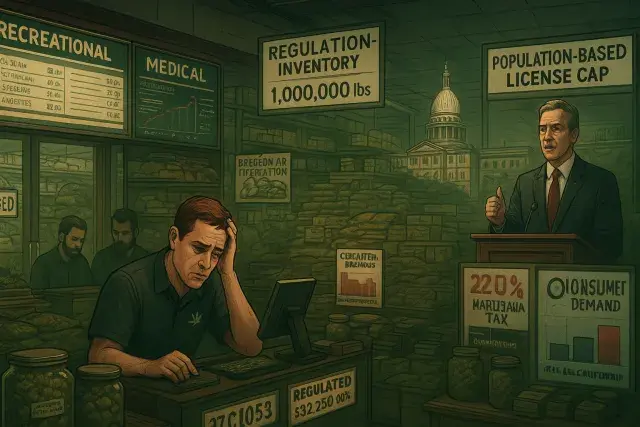
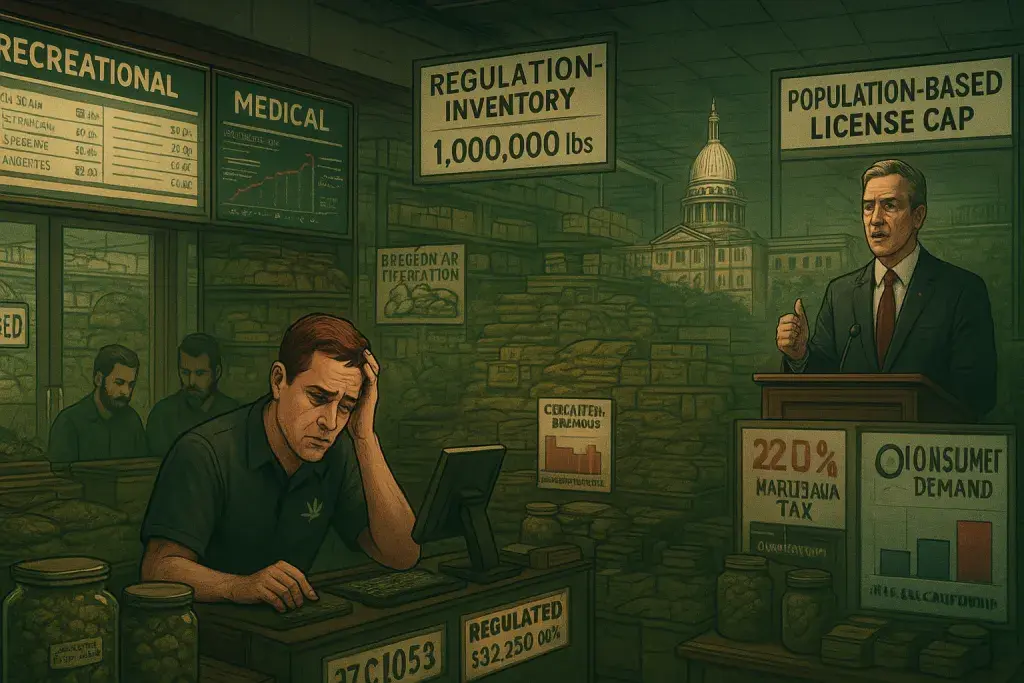
Michigan's adult-use cannabis market posted $257.7 million in recreational sales during May, keeping the state on pace to surpass $3 billion in annual revenue for the second consecutive year. Yet that headline number obscures a market under serious structural strain - one where consumer demand remains among the strongest in the country while wholesale prices and operator margins continue to erode under the weight of excess supply.
The tension playing out in Lansing right now is not unique to Michigan. Regulated cannabis markets from the Pacific Northwest to the Northeast have wrestled with the same arithmetic: legalization opens the door, capital floods in, cultivation capacity outpaces consumption, and prices collapse. States with mature licensing frameworks - including those where operators rely on purpose-built tools like dispensary point of sale alaska to manage compliance, inventory, and sales data - have seen how quickly a high-volume market can shift from expansion to consolidation when supply discipline breaks down. Michigan is now living that lesson in real time, with more than one million pounds of cannabis flower sitting in regulated inventory across grow facilities, processors, and retail stores at the end of May.
State Rep. Brian BeGole (R-Antrim Township) has introduced legislation that would cap marijuana retailer and wholesaler licenses based on population - modeled loosely on how Michigan regulates certain liquor licenses. The bill would not revoke existing licenses; it would establish population-based thresholds that limit future issuances once communities hit those ceilings. Supporters argue the measure could bring structural discipline to a market that has never had it. Critics see it as a mechanism that protects incumbent operators at the expense of new entrants, including social equity applicants who are still working through the licensing pipeline.
The Supply Problem Is Real, but the Bill May Not Address Its Root
Here's the catch: if oversupply is being driven primarily by cultivation capacity, capping retailer and wholesaler licenses doesn't directly solve the problem. Michigan's regulated market currently holds 947 active grow licenses - Class A, B, C, and Excess Grow designations - alongside 836 active adult-use retail licenses. Flower inventory at processing facilities alone stood at 677,402 pounds in May. That's not a retail bottleneck. That's an upstream production problem.
Average retail flower prices fell to $59.73 per ounce in May, which sits among the lowest in any regulated U.S. market. At that price point, margins throughout the supply chain compress to levels that make it genuinely difficult to service debt, cover compliance costs, or absorb the new 24 percent wholesale marijuana tax that took effect January 1. That tax - applied at the wholesale level - hits growers and processors before a single unit moves across a retail counter, effectively functioning as a fixed cost that operators cannot offset by selling more volume when prices are already at the floor.
Approximately 37 dispensaries surrendered or walked away from their licenses in May, according to reporting by Crain's Detroit Business. That's consolidation happening organically, without regulatory intervention. At the same time, the Cannabis Regulatory Agency received 14 new retailer applications and issued seven new retailer licenses during the same month. The market is simultaneously shedding operators who can't sustain the economics and attracting new applicants who believe they can do it differently. That churn has real costs - for employees, for landlords holding cannabis-use leases, and for vendors across the retail technology and supply chain ecosystem.
What Operators Actually Face Day-to-Day
For a dispensary owner trying to manage a retail floor in this environment, the economics are punishing in ways that sales totals don't capture. Increasing transaction volume does not necessarily improve profitability when average basket values are declining alongside per-unit prices. Wholesale menus are crowded and pricing is soft, which sounds like a buyer's advantage - but retailers still carry fixed overhead: payroll, compliant packaging costs, seed-to-sale tracking fees, POS system licensing, security requirements, and state and local licensing fees. None of those costs move with the wholesale price of flower.
Medical marijuana sales, for context, generated just $322,350 in May statewide. The recreational market has so thoroughly absorbed cannabis commerce in Michigan that the medical tier is now functionally marginal. That matters for compliance purposes - operators maintaining dual adult-use and medical licenses carry dual compliance burdens without the medical revenue that once justified them.
What's striking here is that Michigan consumers, by almost any measure, are buying cannabis at an extraordinary rate. Analytics firms have previously reported that Michigan has sold more cannabis units than California despite having roughly one-quarter of California's population. The demand side of this market is not the problem. The supply side - built aggressively during years when wholesale prices could sustain it - has never fully rationalized.
What the Licensing Debate Signals for Michigan's Industry
The BeGole legislation represents something more significant than a single bill. It marks the first open legislative acknowledgment in Michigan that the state's cannabis industry may have built more production capacity than consumer demand can profitably absorb over the long term. That is a different conversation than anything lawmakers were having two or three years ago, when the policy orientation was almost entirely focused on expanding access and increasing license counts.
Whether the bill advances or stalls, the debate itself has operational implications. Investors evaluating Michigan cannabis assets will factor regulatory uncertainty into valuations. Multi-state operators considering Michigan entry or expansion will reassess the timeline. Brands negotiating wholesale agreements will watch wholesale price trends even more closely. And existing licensees - particularly those who have survived consolidation this far - will be watching to see whether Lansing moves to stabilize the market or leaves the industry to sort itself out through continued attrition.
To put it plainly: $258 million in monthly recreational sales is not a market in crisis. But $59-per-ounce retail flower prices, a million-plus pounds of sitting inventory, and dozens of operators surrendering licenses in a single month are not signs of a market in equilibrium either. Michigan's cannabis industry is large, active, and genuinely stressed - and the legislative response to that combination will shape the business environment for every licensed operator in the state.