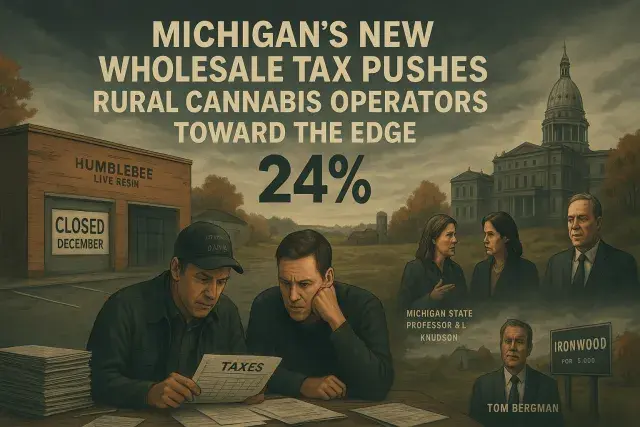
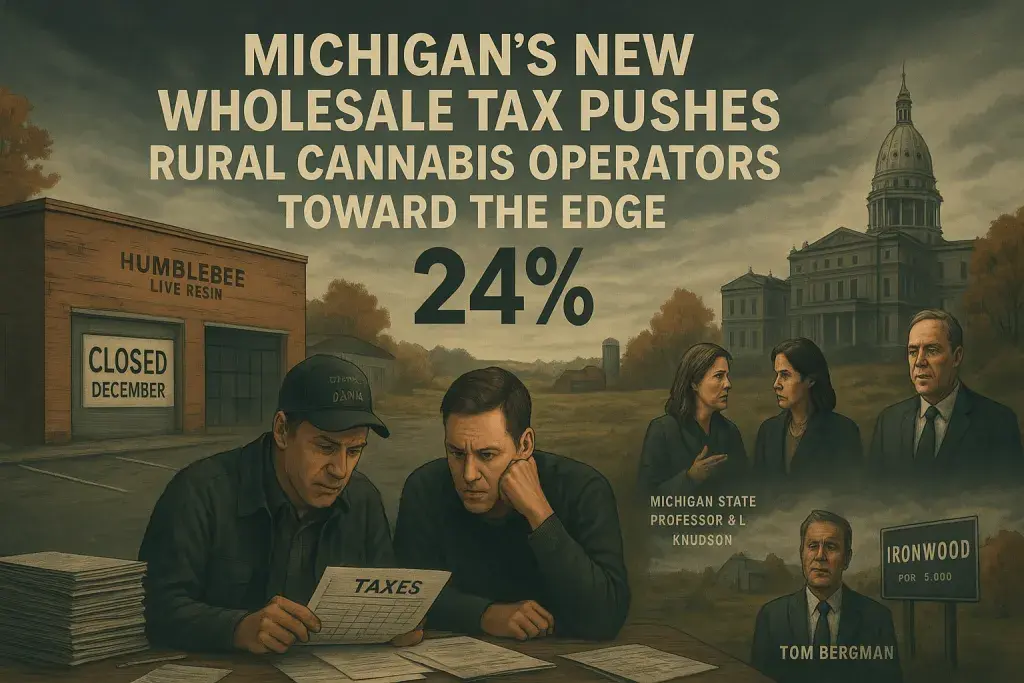
When a marijuana manufacturing plant in Webberville, Michigan - a town of roughly 1,400 people - shut down in December, it took 62 jobs with it. The plant's leadership pointed to two compounding forces: a wholesale market already suppressed by oversupply, and a new 24% state wholesale tax that took effect January 1. The first payment under that tax was due April 20. For small-town cannabis operators, the timing couldn't have been worse.
A Tax Layered on Top of a Market Already Under Pressure
Michigan's cannabis market is, by most measures, oversaturated. More than 800 licensed retail stores move roughly $3 billion in product annually, but that volume has been achieved in part through aggressive licensing - an open structure that has compressed wholesale prices and squeezed margins across the supply chain. Manufacturers, cultivators, and processors have watched per-unit revenue erode steadily as competing licensees flood the wholesale menu with product.
Into that environment, Lansing introduced a 24% wholesale tax as part of a road funding package. It sits on top of the existing 10% adult-use excise tax and a 6% sales tax - a stacked burden that operators say is structurally different from how comparable consumer goods are taxed. The Michigan Cannabis Industry Association has filed two lawsuits challenging the new levy. Whether those challenges succeed or not, the first payment cycle has already arrived.
Bill Knudson, a professor in Michigan State University's Department of Agricultural, Food, and Resource Economics, put it plainly: a lot of these businesses are operating on very thin profit margins, and a new tax obligation could force some out entirely. Derek Norman, founder of Humblebee - a Frederic-based live resin producer - framed it in supply chain terms: Michigan's open licensing structure had already compressed margins before the tax landed, so operators absorbing the new cost are doing so from a position of financial fragility, not stability.
Supporters of the tax argue the market was contracting regardless. State Sen. Ed McBroom, who represents much of the Upper Peninsula and voted for the measure, contends the new rate puts Michigan roughly in the middle of the national range for cannabis tax burdens, and that the consolidation underway reflects oversaturation - not the tax itself. That argument is fair enough as far as it goes. The problem is that "regardless of cause" isn't much comfort to an operator who can no longer cover the spread between wholesale cost and retail price.
Rural Communities Took the Earliest Risk - and Now Face the Sharpest Exposure
Here's what makes the consolidation story more than a standard industry correction: rural Michigan municipalities were disproportionately early adopters of adult-use cannabis licensing. In 2020, when fewer than 70 cities, townships, and villages had voted to allow cannabis businesses, two-thirds of those jurisdictions had populations under 10,000. Those communities contained nearly half the state's retail licenses at the time.
That early-mover status generated real fiscal returns. Baldwin Township in Iosco County - population roughly 1,600 - has received close to $900,000 in state marijuana tax distributions since its first dispensary opened in 2020, growing its general fund by 78%. That revenue funded capital projects, including a bike path connecting Tawas Point State Park to the Iron Belle Trail - infrastructure the township couldn't have afforded otherwise without a tax increase. Ironwood, near the Wisconsin border with around 5,000 residents, pulled in more than $783,000 in cannabis tax revenue sharing since 2022, expanding its general fund by 66%.
The catch is that the same small scale that made cannabis revenue transformative also makes any loss of it acute. Stephanie Leiser, director of the Center for Local, State and Urban Policy at the University of Michigan, noted the asymmetry directly: losing one license out of 30 or 40 is manageable; losing one out of five is a structural hit to a town's budget. Baldwin Township, which once had five dispensaries operating, now has two.
The Webberville plant closing is a concrete version of that math. Sixty-two jobs in a town of 1,400 is not an abstraction - it's a meaningful percentage of the local workforce, gone in a single operational decision driven partly by tax policy set in Lansing.
What Consolidation Actually Looks Like in Retail Operations
Industry consolidation in cannabis isn't simply about licenses disappearing. It reshapes the wholesale relationship between cultivators, manufacturers, and retailers; it concentrates purchasing power with multi-store operators; and it tends to pull investment back toward higher-density markets where foot traffic can absorb fixed compliance costs more easily.
Mike DiLaura, chief corporate officer at House of Dank and a board member of the Michigan Cannabis Industry Association, operates 15 stores across the state, including locations in smaller markets like Traverse City and New Buffalo. His read is realistic: some stores in rural communities won't survive the current compression. But the investment in those markets - often involving the acquisition and renovation of vacant commercial properties - has already created durable value, even if a particular license eventually lapses. That's a reasonable framing for a multi-store operator with the balance sheet to absorb losses at individual locations. For a single-site owner-operator in a town of 1,500, it's a different calculation entirely.
The wholesale tax accelerates a dynamic that was already sorting the market toward verticalized, better-capitalized operators. Businesses that control cultivation, manufacturing, and retail under one license structure can internalize the wholesale tax hit across their own supply chain in ways that independent manufacturers selling to third-party retailers simply cannot. That isn't a flaw in the tax design so much as a predictable consequence of applying a flat-rate wholesale levy to a market with wildly unequal operator scale.
The Policy Tension That Isn't Going Away
Michigan's new wholesale tax raises a structural question that other adult-use states are watching: how do you fund public infrastructure through cannabis taxation without accelerating consolidation to the point where the tax base itself shrinks? If enough small and mid-size operators close, the total wholesale tax revenue may underperform projections - and the rural communities that built budget dependency on cannabis distributions will be the first to feel that shortfall.
Tom Bergman, community development director in Ironwood, said he was concerned when he heard about the new tax. That concern is warranted at the local government level. Cannabis excise and tax-sharing revenues have become genuine line items in rural Michigan municipal budgets - not supplemental windfalls, but funds tied to specific capital planning cycles. A material drop in licensed operators, or a contraction in the wholesale market that reduces taxable transaction volume, flows through to those distributions.
For dispensary owners and manufacturers operating in Michigan right now, the immediate operational question is whether their current margin structure survives the stacked tax obligation. For those on the edge, the April 20 payment deadline was a real stress test - and for some, it will prove to be the last one they file.