
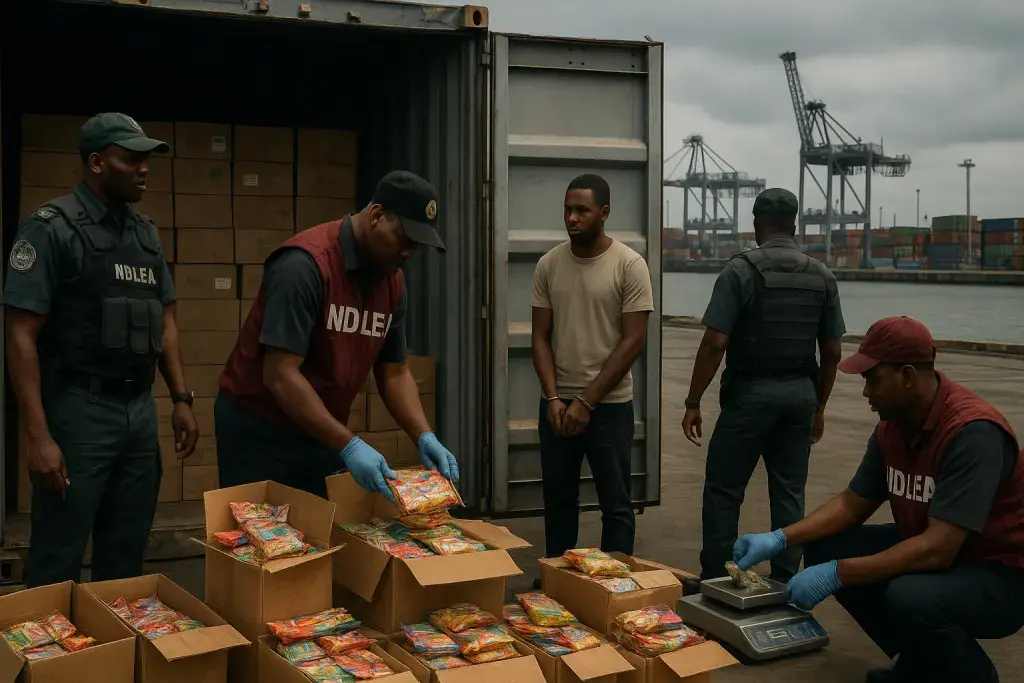
Nigerian drug enforcement officers seized 442 packets of cannabis-infused cookies and gummies, totaling 309.4 kilogrammes, hidden inside a 40-foot shipping container at the TinCan Island Port Complex in Lagos. The discovery came during a joint examination by the National Drug Law Enforcement Agency, the Nigeria Customs Service, and other security agencies on August 4, and it points to a persistent problem for jurisdictions where cannabis remains illegal: infused products moving through legitimate trade channels disguised as ordinary confectionery.
The consignment was packed in 73 cartons, and one suspect, Larry Nnaji, was arrested in connection with the shipment, according to a statement from NDLEA spokesperson Femi Babafemi. What's striking here is not just the volume but the packaging strategy - infused edibles formatted to resemble commercial snack goods are notoriously difficult to flag during routine cargo screening, which is precisely why customs and enforcement teams lean on manifest audits and physical inspection rather than visual inspection alone. In markets where cannabis retail is legal, this same packaging resemblance problem drives strict labeling mandates, child-resistant packaging rules, and batch-level tracking; operators in regulated states manage that burden with software built for cannabis retail that ties every SKU to a tested, labeled, and traceable batch from intake to point of sale. software built for cannabis retail
Why Edibles Present a Distinct Enforcement Challenge
Infused cookies and gummies are harder to intercept than raw plant material because they don't carry an obvious visual or olfactory signature once sealed in commercial-style packaging. That's a headache for customs officers working under time pressure at high-volume ports. It's also a reminder, for anyone watching the compliant side of the industry, of why regulated markets require lab testing and certificates of analysis before an edible product ever reaches a dispensary shelf. Without that verification step, there's no way to confirm potency, dosing consistency, or contamination risk - the exact uncertainty that makes trafficked edibles a consumer-safety concern wherever they surface, licensed market or not.
A Broader Enforcement Pattern Across Nigerian States
The TinCan seizure was one of several actions NDLEA operatives carried out between August 3 and August 8. In Oyo State, a raid on a drug warehouse in Orire Local Government Area recovered 731.03kg of illicit drugs and led to the arrest of Felicia Thompson, while an alleged partner remains at large. Edo State operatives, working with military support, recovered 65 jumbo bags of skunk weighing 604.5kg. Smaller but notable actions followed in Abia State, where 7kg of skunk was recovered from a drug joint operator, and in Lagos, where a wanted suspect was arrested after a three-month manhunt with 88.5kg of skunk in his possession.
What This Means for Legitimate Trade and Regulatory Oversight
For port operators, freight forwarders, and customs brokers, incidents like this tend to translate into slower clearance times and more intensive container inspections across the board - not just for suspect shipments. That's the friction cost of enforcement: legitimate importers absorb delays because bad actors keep testing the same channels. NDLEA Chairman Brig. Gen. Mohamed Buba Marwa (retd.) commended the commands involved and urged personnel to sustain enforcement momentum, while also directing officers to maintain what he described as a balanced approach - combining interdiction with broader drug-control measures. For any jurisdiction weighing cannabis policy reform, cases like this underscore a recurring argument from regulated-market advocates: transparent supply chains, verified lab testing, and licensed distribution are generally easier to monitor than unregulated trafficking routes, though that comparison doesn't erase the compliance burden legal operators still carry.