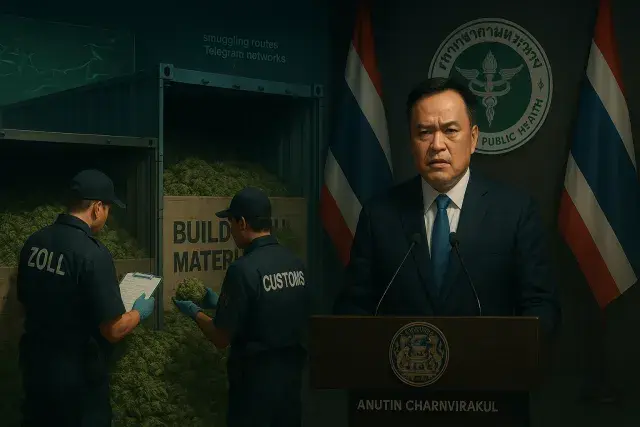
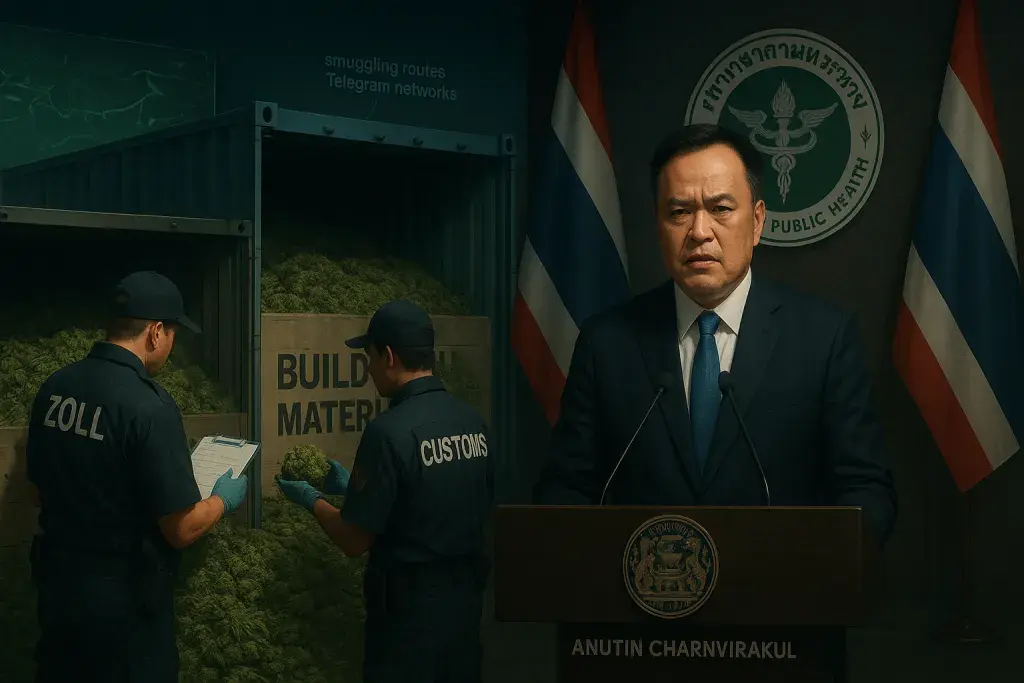
Four years after Thailand became the first Asian country to decriminalize cannabis, a string of major international seizures is pushing Bangkok toward reversing course. German customs disrupted a sea corridor last week, pulling 1.2 tonnes of Thai cannabis from containers of building materials - a seizure valued at more than US$13 million. The same day, Indonesian authorities seized 3.37 tonnes of cannabis buds from Thailand in East Java, arresting twelve people including several Thai nationals. For an industry that once looked like a regional template for reform, the optics are deteriorating fast.
Prime Minister Anutin Charnvirakul has said bluntly that he is prepared to shut the industry down. "No matter how strict our measures are, if people can still smuggle drugs out, we need to go back and reassess our approach," he told reporters. That kind of political language - from a figure who championed the original decriminalization - signals how quickly a regulatory framework can unravel when enforcement infrastructure fails to keep pace with market growth. The comparison to more mature regulated markets is instructive: in U.S. states with robust adult-use programs, seed-to-sale tracking systems, METRC integrations, and real-time compliance reporting are precisely the tools designed to close the gap between licensed production and illicit diversion. An Ohio dispensary POS platform, for instance, operates within a compliance architecture that logs every transaction, every inventory movement, and every wholesale transfer - the kind of chain-of-custody visibility that Thailand's framework, by most accounts, never fully established at the cultivation level.
The trafficking routes themselves tell a damaging story about what happens when licensing outpaces oversight. British nationals have been repeatedly caught couriering product from Thailand via routes organized through Telegram, with crime networks reportedly offering free holidays in exchange for carrying packages. That is not an isolated customs problem. It reflects a supply-chain integrity failure - one that any operator familiar with compliant wholesale logistics would recognize immediately. When farm-gate prices collapse and illicit exporters can offer margins that legitimate channels cannot match, product finds the path of least resistance. A licensed grower in northeastern Thailand told reporters that per-kilogram prices had fallen from over 10,000 baht to roughly half that, leaving only large medicinal operations and illegal exporters able to profit. The legal market, in short, had been undercut by the very conditions it created.
Regulatory Pressure Mounts, But Enforcement Architecture Arrives Late
Thailand's Ministry of Public Health has now ordered stricter inspections of licensed cultivation sites nationwide, with provincial health offices directed to work alongside local administrative officials and the Royal Thai Police. The Department of Thai Traditional and Alternative Medicine has scheduled coordination meetings with provincial public health offices to align on two priorities: tighter compliance with licence conditions and joint enforcement inspections. Growers found in violation face licence suspension or revocation. That is the right response on paper - but it arrives after years of what legitimate operators describe as a market already captured by volume players and criminal competition.
Here's the catch: intensified inspection regimes applied retroactively to a fragmented cultivation sector rarely produce clean results. Without digital inventory tracking, standardized compliance logs, or chain-of-custody documentation embedded at every stage from seed to wholesale transfer, inspectors are working from paper records against actors who have had years to learn the system's gaps. The parallel in U.S. markets that have struggled with diversion - unlicensed deliveries, unreported harvests, inventory shrinkage that never reconciles in the POS - is a familiar one. Enforcement alone does not close those gaps. Technology-backed compliance infrastructure has to be built into the licensing framework from the start, not bolted on after international seizures make headlines.
What Re-Criminalization Would Actually Mean for the Licensed Sector
For the businesses that built operations in good faith under Thailand's decriminalization framework - growers, processors, dispensary-style retail shops - the prospect of re-criminalization is an existential licensing risk, not a policy abstraction. Licences revoked by regulatory reversal, rather than by individual violation, generally offer operators little recourse. Capital invested in cultivation infrastructure, compliance buildouts, and retail operations would be stranded. That is a lesson that cannabis businesses in any jurisdiction should read carefully: regulatory frameworks that move faster than their enforcement infrastructure can support are structurally fragile, regardless of how progressive the underlying policy intention is.
The broader implication for international cannabis markets is straightforward. Diversion from a loosely regulated source country does not stay local - it pressures diplomatic relationships, triggers foreign enforcement responses, and ultimately gives political opponents of reform the evidence they need to argue for rollback. Germany's customs announcement and Indonesia's arrests were not just law enforcement events; they were regulatory arguments delivered by governments that have no interest in protecting Thailand's cannabis industry. That kind of external pressure is difficult for any domestic political coalition to absorb indefinitely. Whether Thailand re-criminalizes or instead builds the compliance architecture it should have deployed in 2022, the industry's current trajectory is not sustainable.