Virginia has finalized the regulatory framework for its adult-use cannabis retail market, including a phased rollout that begins affecting hemp retailers as early as August 2026 - more than a year before licensed dispensaries are permitted to open their doors on July 1, 2027. The plan, reached through budget negotiations between the General Assembly and Governor Abigail Spanberger, addresses enforcement powers, product restrictions, tax earmarks, and social equity measures in a single comprehensive package. For operators and suppliers watching Virginia closely, the operative word is now - because the compliance clock started running the moment this framework was announced.
Retail cannabis operators planning to enter the Virginia market will need to track multiple regulatory layers simultaneously, and POS infrastructure will matter from day one. Systems capable of managing compliant inventory, flagging non-conforming SKUs, and generating audit-ready logs - like this dispensary POS built for regulated cannabis retail - represent exactly the kind of back-office investment that separates operators who are ready at launch from those still scrambling at the counter. Virginia's framework is detailed and enforced; the technology has to match.
The Hemp Crackdown Comes First
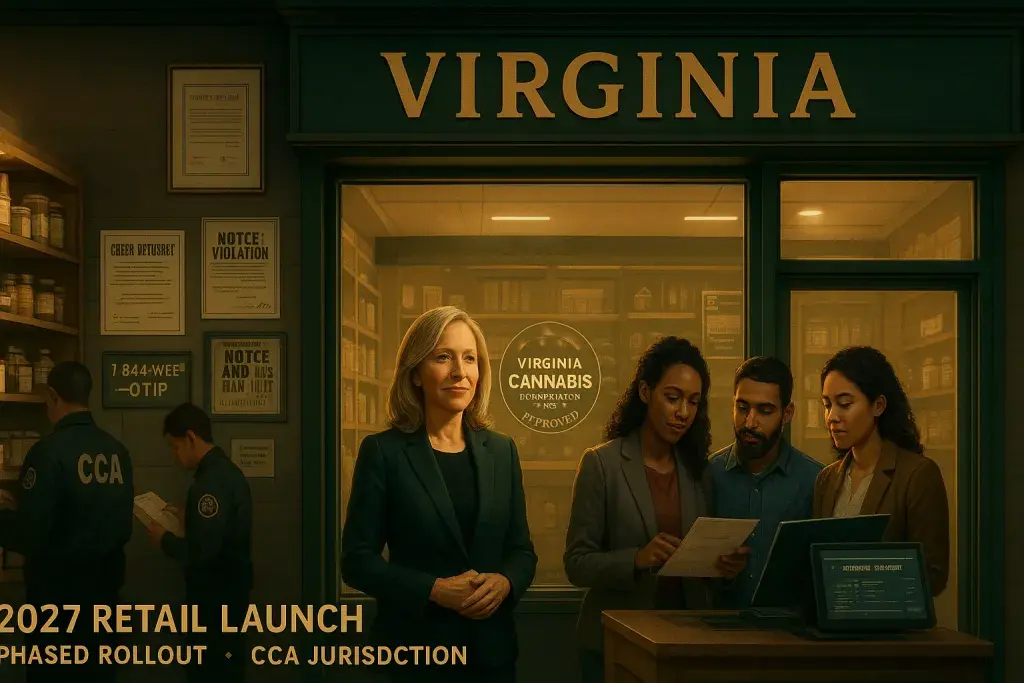
Here's the catch for anyone currently selling hemp-derived products in Virginia: the regulatory shift hits before retail cannabis even opens. Starting in August 2026, oversight of all hemp-derived products moves from the state's agriculture authority to the Virginia Cannabis Control Authority - the CCA. That jurisdictional transfer alone signals a hard change in enforcement philosophy; this is no longer an agricultural commodity question, it's a controlled-substance compliance question.
Then, on August 15, 2026, the so-called "25:1 loophole" closes for good. Under the old rule, hemp products could exceed two milligrams of THC per package if they maintained a 25:1 CBD-to-THC ratio - a workaround that effectively allowed relatively high-THC products to circulate outside the licensed cannabis supply chain. The new rule is straightforward: no product containing more than two milligrams of total THC per package may be legally produced or sold as a hemp product in Virginia. Full stop. Retailers carrying high-ratio CBD products with elevated THC content will need to audit their budroom inventory before that date or face removal from shelves entirely.
What's striking here is the timing. This isn't a grace period measured in weeks - operators have roughly a year to reformulate sourcing relationships, work with brand partners, and update product menus. That sounds manageable, but wholesale menus across the hemp supply chain will have to adjust in parallel, and smaller regional brands supplying Virginia retailers may not move quickly. Operators who wait until mid-2026 to assess their SKU compliance exposure will almost certainly be caught short.
Enforcement Gets Real Teeth
Senate Bill 543 grants the CCA immediate enforcement authority - not the drawn-out notice-and-response cycles that have blunted regulatory effectiveness in other states. The CCA can now issue notices of violation, levy civil penalties, and hand down cease-and-desist orders to unlicensed operators directly. That's a meaningful escalation from the prior framework.
The state is also adding a public reporting mechanism: a formal online portal and a toll-free hotline - 1-844-WEED-TIP - for residents to report suspected illegal commercial activity. Whether that generates actionable enforcement data or becomes a noise machine remains to be seen, but the infrastructure signals that Virginia intends to treat unlicensed operators as a genuine market integrity problem, not a background nuisance. Licensed retailers, for their part, will be required to display a state-issued compliance decal in their store windows. Small detail - real operational requirement.
Tax Revenue, Equity, and the Bigger Policy Picture
The 2027 retail market comes with built-in revenue earmarks: future excise tax receipts are designated for public education, health care initiatives, addiction treatment programs, and communities historically over-policed under prior drug enforcement regimes. That language mirrors social equity frameworks adopted in other adult-use states, though the proof of those commitments typically lives in the appropriations process - not just the enabling legislation.
A cluster of companion bills rounds out the framework. House Bill 391 and House Bill 75 expand medical cannabis access for terminally ill patients. Senate Bill 230 and House Bill 26 create expungement pathways for past marijuana-related records and allow sentence modifications - policies that directly affect who can realistically pursue a cannabis business license in Virginia going forward. House Bill 942 adds protections for parental rights around authorized substance use, a provision that tends to surface in adult-use states as a counterweight to employer and family-court disputes involving legal cannabis.
Governor Spanberger had vetoed an earlier retail market bill in May, citing public health concerns, youth safety, implementation complexity, and cost. The finalized framework is the product of that friction - which, to put it plainly, is how cannabis regulation is supposed to work. The resulting rules are more detailed, more enforceable, and more explicitly funded than what typically emerges from a first-pass legislative effort. Existing hemp retailers will receive direct state communication regarding registration renewals as the August 2026 transition approaches. Operators watching from outside the state would do well to treat Virginia's rollout as a case study - it reflects a maturing approach to adult-use regulation that other legislatures are likely watching closely.