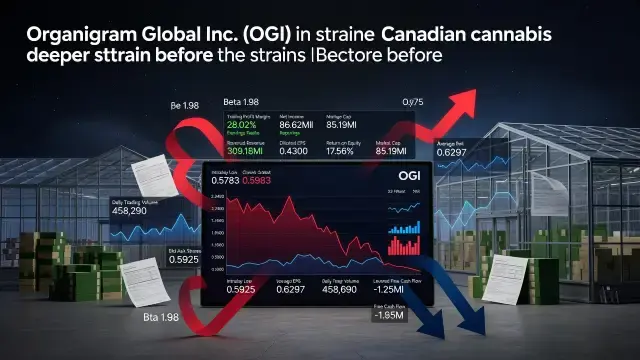
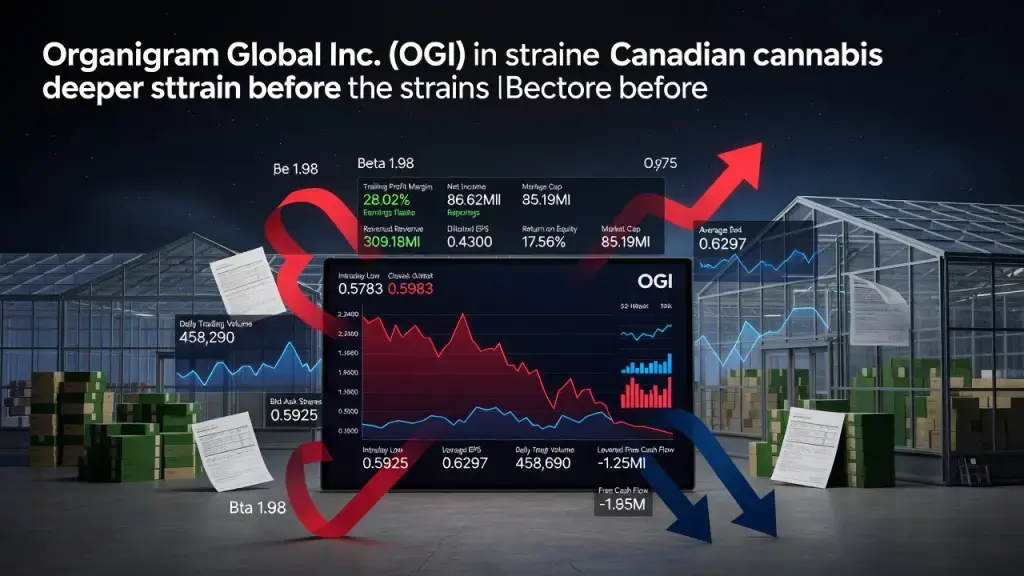
Organigram Global Inc. (OGI) is trading near the bottom of its 52-week range, closing a recent session at 0.5983 after opening slightly lower and dipping as far as 0.5783 intraday. The stock's 52-week range - 0.5783 to 2.2400 - tells its own story: a company that has lost most of its market value over the past year, even as its underlying financials show flashes of profitability that would, on paper, suggest otherwise.
A Profit Margin That Doesn't Match the Share Price
Here's the catch. Organigram reports a trailing profit margin of 28.02% and net income available to common shareholders of 86.62 million on trailing twelve-month revenue of 309.18 million. Diluted EPS sits at 0.4300, and return on equity is a respectable 17.56%. Those are not the numbers of a company in distress. Yet the stock trades at a market cap of roughly 85.19 million, with a beta of 1.98 - meaning it swings nearly twice as hard as the broader market in either direction. That mismatch between reported earnings and market valuation is the kind of thing that makes analysts and operators alike raise an eyebrow. In practice, though, Canadian cannabis equities have spent years disconnected from fundamentals, weighed down by oversupply, provincial distribution bottlenecks, and investor fatigue that predates any single company's balance sheet.
What the Balance Sheet Says About Operating Pressure
Total cash on hand sits at a modest 11.67 million against total debt-to-equity of 5.69% - a relatively conservative capital structure, at least on the surface. Levered free cash flow, however, is negative at -1.25 million, and return on assets trails at -0.60%. For a licensed producer operating under Health Canada's cultivation and processing framework, that combination points to a business generating accounting profit while still burning cash in operations - not unusual in an industry where excise tax remittances, packaging compliance costs, and provincial board pricing pressure margins long before product reaches a retail shelf. Canadian cultivators answer to a different compliance regime than U.S. state-licensed operators, but the underlying economics rhyme: thin wholesale margins, heavy regulatory overhead, and a retail channel largely controlled by provincial boards rather than the producer itself.
Trading Volume and Volatility Tell the Real Story
Daily volume of 458,690 shares, against an average of 578,784, suggests trading has cooled somewhat from its typical pace - not a collapse in interest, but not a rush either. The bid-ask spread (0.5925 x 500 versus 0.6297 x 500) is wide enough to matter for smaller investors trying to move in or out of a position without eating a meaningful spread cost. A trailing P/E of 1.40 looks almost nonsensical at first glance, and it is - low single-digit P/E ratios in this sector usually reflect one-time gains, asset revaluations, or accounting adjustments rather than sustainable per-share earnings power. Investors reading EPS and margin figures at face value, without digging into what drove them, risk drawing the wrong conclusion about operational health.
Why This Matters Beyond One Ticker
Organigram's situation is a useful proxy for the broader Canadian licensed producer segment: companies that survived the first wave of market consolidation now face a second test - proving that reported profitability translates into durable cash generation. For wholesalers, brand partners, and retail buyers evaluating supply relationships with any licensed producer, the lesson is to look past headline earnings and toward free cash flow, debt servicing capacity, and the stability of provincial distribution agreements. A supplier's stock volatility doesn't directly dictate product availability or compliance standing, but it does signal how much financial cushion a producer has to absorb supply chain disruptions, packaging recalls, or shifts in provincial purchasing patterns. With no forward dividend, no analyst 1-year target estimate currently listed, and a Neutral rating from at least one tracking service, the market's message on Organigram right now is caution, not conviction.