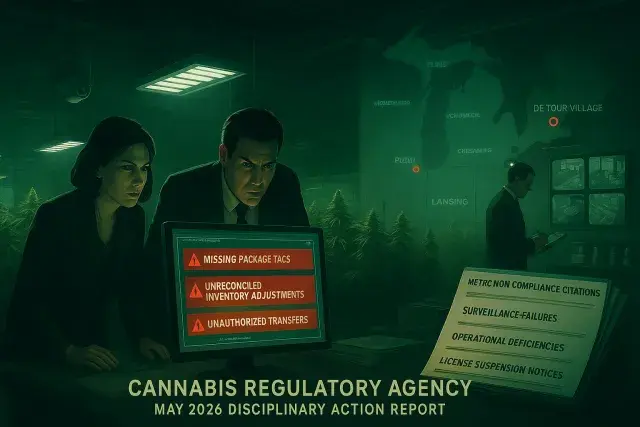
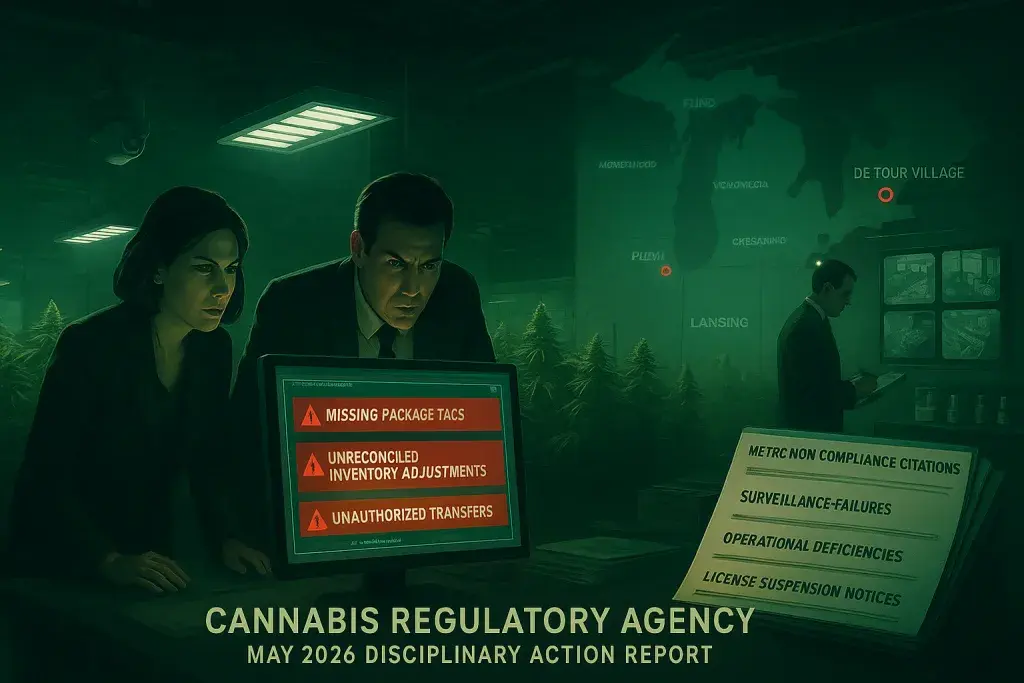
Michigan's Cannabis Regulatory Agency flagged 16 licensed cannabis businesses in its May 2026 Disciplinary Action Report, with seed-to-sale tracking violations leading the count - eight of the cited businesses received METRC non-compliance citations stemming from investigations completed during April. The enforcement sweep covered adult-use retailers, cultivators, processors, safety compliance laboratories and medical marijuana licensees spread across twelve cities, from Flint and Lansing to De Tour Village and River Rouge. Most violations were administrative and operational rather than product safety failures or criminal conduct, but that distinction doesn't soften the compliance exposure for the businesses involved.
METRC is Michigan's required seed-to-sale tracking platform, used to record every cannabis plant and product as it moves through cultivation, processing, transportation and retail sale. When that chain of custody breaks - missing package tags, unreconciled inventory adjustments, transfers that don't match corresponding records - regulators lose visibility into where product went and why. That's not a paperwork technicality. It's the mechanism by which licensed market operators demonstrate they aren't diverting product into unregulated channels. Operators in neighboring states running platforms like IndicaOnline dispensary software in Minnesota will recognize the same operational pressure: state-mandated track-and-trace integrations require consistent, real-time data hygiene, and gaps compound quickly when staff aren't trained or processes aren't formalized. Eight businesses across seven Michigan cities failed that standard in April alone.
Several businesses received multiple citations from a single investigation - which tells you something about how compliance failures tend to cluster. Moneylineholdings Limited LLC in Chesaning collected four separate disciplinary actions covering METRC compliance, surveillance requirements, employee issues and unauthorized transfers between marijuana businesses; one of those actions carried a license suspension. Royal Highness LLC in River Rouge was cited across four violation categories: general operational deficiencies, METRC compliance, reporting issues and surveillance failures. Palmate Solutions LLC in Jackson drew citations for general operational deficiencies and failure to report material changes to its licensed operations. The pattern here is familiar in regulated cannabis markets - an operator that's behind on one compliance system is often behind on several simultaneously, because the root cause is usually an infrastructure or staffing problem, not a one-off mistake.
What the Violation Categories Actually Signal
Beyond METRC, the May report cited businesses for general operational deficiencies, non-compliant sales, surveillance and security failures, employee compliance issues, Administrative Financial Statement deficiencies, improper transfers between licensed businesses, reporting failures and production violations. That's a broad cross-section. Surveillance and security failures matter because Michigan requires licensed premises to maintain camera coverage and retain footage - it's a condition of licensure, not a suggestion. Unauthorized transfers between marijuana businesses go directly to supply chain integrity; product that moves between licensees without proper documentation creates exactly the kind of inventory gap that METRC is designed to prevent. Administrative Financial Statement deficiencies suggest some operators may be struggling with the back-office rigor that regulators treat as a baseline expectation.
The Operational Reality Behind Recurring METRC Problems
Here's the thing about seed-to-sale tracking failures: they're rarely mysterious. Untagged harvests, manual adjustments that don't get reconciled, retail transactions that close without proper package updates - these are process breakdowns, and they happen when operators treat METRC as an afterthought rather than as the operational spine of a licensed cannabis business. The CRA, like most state cannabis regulators, requires licensees to maintain accurate, real-time inventory records and to correct discrepancies promptly when they appear. Businesses that don't build internal audit routines - routine physical inventory counts matched against METRC records, staff training tied to actual POS and tagging workflows - are essentially running a compliance deficit that enforcement actions eventually surface.
For multi-location operators or anyone considering expansion in Michigan, the May report is worth reading carefully. The CRA publishes these disciplinary documents through its online cannabis license verification database as part of its public transparency framework. Prospective partners, investors, landlords and wholesale suppliers can and do check those records. A license suspension on a business's public file doesn't disappear quickly, and the reputational weight in a regulated B2B environment is real. Operators who treat monthly enforcement reports as irrelevant to their own shop are missing the signal: the CRA is actively investigating, and operational shortcuts that might go unnoticed for a quarter rarely survive a full inspection cycle.