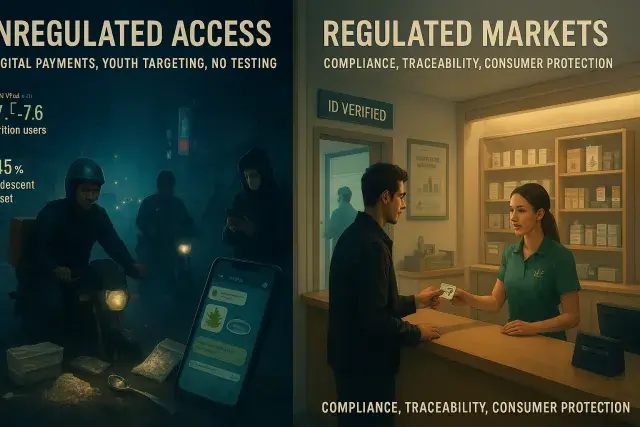
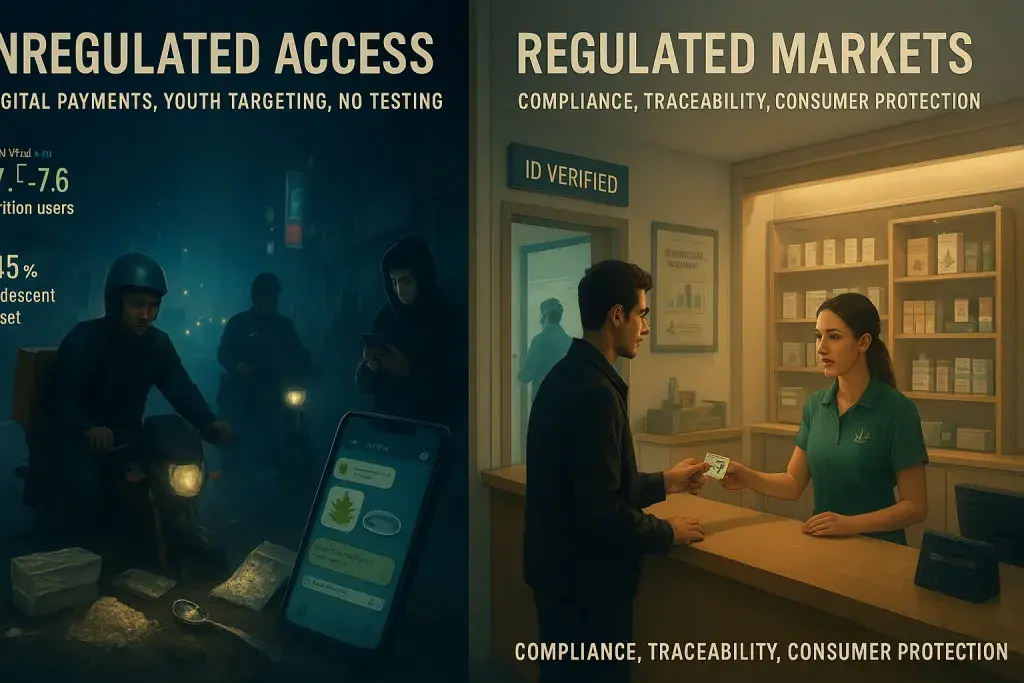
A detailed editorial in Pakistan's The News International, citing the World Drug Report 2026, describes a country where narcotics are increasingly ordered through digital channels, paid for through electronic transactions, and delivered using young people recruited as couriers under false promises of easy income. The Anti-Narcotics Force has flagged that synthetic drugs - more potent and easier to conceal than traditional substances - are moving through these channels with minimal friction. The numbers cited in Pakistan's own research are stark: an estimated 6.7 to 7.6 million people across the country use drugs, with roughly four million requiring structured treatment, and heroin and cannabis together accounting for the majority of documented substance abuse cases among young users.
For anyone working in regulated cannabis markets - operators, compliance officers, policy advocates - this is not a foreign-policy story to scroll past. It is, in the starkest possible terms, a demonstration of what consumer access to cannabis and other controlled substances looks like when there is no licensed retail infrastructure, no age-gating at the point of sale, no testing requirement, no compliant packaging, and no seed-to-sale accountability. Regulated adult-use markets in states like Massachusetts were built precisely to displace this kind of unregulated distribution model; to learn more about how those frameworks operate in practice, the compliance architecture alone illustrates how much separation exists between a licensed dispensary and a chat-based drug transaction. The Pakistan case makes the value of that architecture visible in negative relief.
What's striking here is the mechanism the report identifies. Digital payment infrastructure - the same kind of fintech expansion celebrated as economic development - is being used to reduce the friction of illicit drug procurement. When a transaction that once required a physical handoff can be completed through a messaging app and a mobile payment, the access barrier drops significantly. In regulated cannabis markets, this dynamic is exactly why cashless payment compliance is treated seriously rather than as a formality. PIN debit systems, cannabis-specific payment processors, and the ongoing push for full banking access under frameworks like the SAFE Banking Act all exist partly because financial traceability is one of the few structural levers regulators have over a cash-intensive industry. Remove that traceability, and you get closer to the model Pakistan is struggling with - untraceable, unaccountable, and difficult to interdict.
Youth Access and the Limits of Demand-Side Warnings
The Pakistani research cited in these reports found that 35 percent of substance abusers began using drugs during adolescence. A 2024 survey at Karachi University found that 44 percent of university and college students admitted to drug use, with a growing share reporting online procurement. These figures describe a market that has found its most accessible customers among the least-protected demographic. In regulated adult-use retail, age verification at the point of sale is non-negotiable - government-issued ID checks before any transaction, with serious licensing consequences for violations. The enforcement mechanism is imperfect, but it exists. In an unregulated online market, it doesn't exist at all.
The courier recruitment problem is worth pausing on. Young people being drawn into drug distribution networks through promises of fast money is not a new phenomenon, but the digital overlay changes the recruitment pipeline. What once required in-person contact can now happen through social media. Regulated operators deal with a version of this reputational risk differently - delivery driver compliance, manifest verification, and chain-of-custody documentation are standard requirements in licensed cannabis delivery operations precisely because regulators need to know who handled what product, when, and where. It is not glamorous compliance work. But it is the infrastructure that keeps a legal delivery operation distinguishable from an unregulated one.
What Regulated Markets Are Actually Defending Against
Cannabis legalization debates often collapse into arguments about whether regulation enables access. The Pakistan situation argues the inverse: the question is not whether access exists, but what conditions govern it. Unregulated access, as documented here, means no potency limits, no lab testing, no certificate of analysis, no child-resistant packaging, no licensed retail staff trained in responsible sales, and no legal recourse when the product is adulterated or misrepresented. In a regulated adult-use dispensary, every product batch on the floor has passed third-party testing, carries required labeling, and sits behind an age-gated sales floor with documented compliance logs. That is not a trivial distinction.
The report also notes the rise of synthetic drugs described as more potent and harder to detect. In regulated markets, novel psychoactive substances and synthetic cannabinoids are explicitly excluded from the licensed product category - they cannot be sold through a compliant POS system, they cannot receive a COA from a licensed lab, and their presence in a dispensary's inventory would constitute a serious licensing violation. The illicit market has no such constraint. To put it plainly: the compliance burden that licensed operators sometimes resent is also the mechanism that keeps the most dangerous products out of their supply chain.
The Policy Signal for Markets Still Building Regulatory Frameworks
Pakistan is not building a cannabis retail framework. But the pattern it describes - digital payment ease, youth targeting, synthetic product proliferation, courier recruitment - is a useful reference point for regulators in markets that are still writing rules. Regulatory gaps in advertising restrictions, delivery verification, and payment traceability in licensed markets are not abstract concerns. They are the edges along which unregulated behavior tends to grow. Dispensary operators and compliance teams working in early-stage regulated markets have a direct interest in regulators who understand this, because a weak regulatory frame tends to generate the kind of enforcement overcorrections that burden compliant businesses most.
The Pakistan situation is, in the end, a case study in what happens when a market exists without the infrastructure to govern it. Regulated cannabis retail is that infrastructure - imperfect, expensive to maintain, and perpetually contested. But the alternative is not absence of markets. It is markets that look like the one described here.