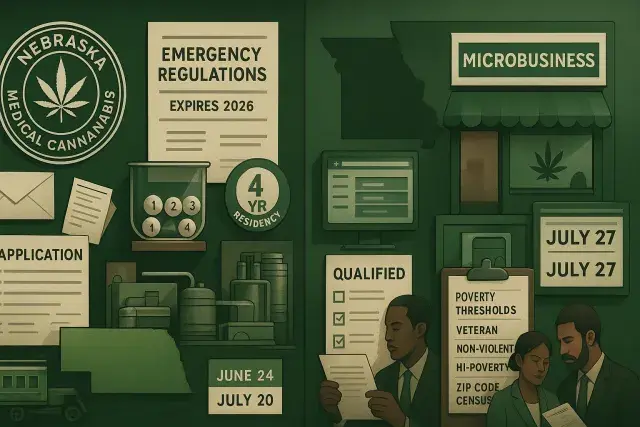
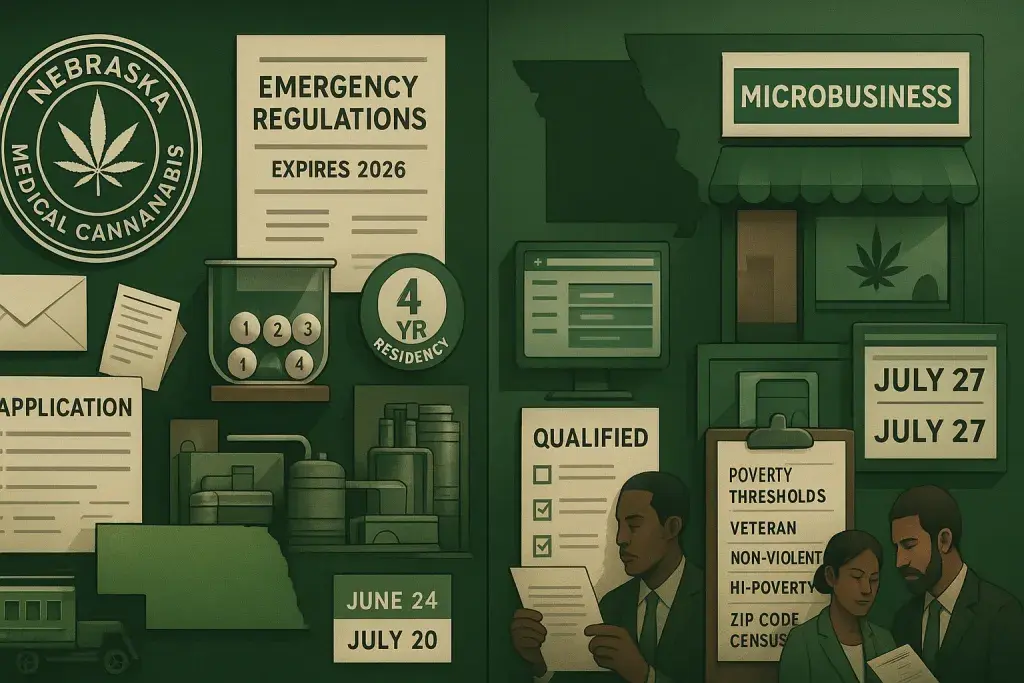
Two states are moving simultaneously to expand their licensed cannabis markets this summer, with Nebraska accepting its first-ever product manufacturing applications and Missouri reopening its Microbusiness program for an additional round of dispensary and wholesale licenses. Both application windows close in late July, and both states are targeting fall award timelines. For operators, investors, and compliance professionals watching state-by-state expansion, the windows are short and the eligibility rules are specific enough to knock out underprepared applicants before they even get to the lottery.
The administrative mechanics of licensing rounds like these place real operational demands on prospective licensees well before a single product moves through a facility. Tracking application deadlines, managing submission logistics, and modeling early-stage compliance costs requires the kind of back-office infrastructure that newer market entrants often underestimate. Operators with experience in adjacent regulated states - including those who rely on this dispensary POS to manage inventory, sales data, and compliance reporting - understand that the technology and workflow decisions made at the licensing stage tend to follow a business for years. Getting them right early matters.
Nebraska's licensing round is structurally unusual. The state is awarding just four Product Manufacturing licenses, submitted via email or physical mail to the Nebraska Medical Cannabis Commission - no online portal, no third-party submission system. The lottery-based award process means a qualified applicant's fate is partly procedural: meet the requirements, clear the residency threshold, and your odds are as good as anyone else's. That said, the residency requirement carries real teeth. Majority ownership must rest with Nebraska residents who have lived in the state for no fewer than four consecutive years immediately before applying. Officers and directors of any applying entity must also be Nebraska residents. This is not a market where an out-of-state multi-state operator can structure around the rule with a thin local ownership arrangement.
Nebraska's Regulatory Timing Creates Compliance Uncertainty
Here's the catch with Nebraska: the program is currently running under Emergency Regulations set to expire July 15, 2026 - essentially in the middle of the application window. Those regulations can be extended for an additional 90 days, but that still leaves applicants preparing for licensure under rules that may shift before a license is actually awarded. For a product manufacturer trying to design a facility, source equipment, or negotiate a lease, that regulatory uncertainty is not a minor footnote. Build-out decisions made under the current Emergency Regulations could require adjustment once permanent rules are finalized.
There is also the matter of product scope. Nebraska does not permit cannabis flower, which means Product Manufacturing licensees are not stepping into a simple cultivation-to-retail pipeline. They are the functional backbone of the state's medical program - responsible for producing the finished cannabis products that patients can actually access. The NMCC may also require these licensees to handle transportation of cannabis and cannabis products, adding a logistics dimension to what might otherwise look like a straightforward manufacturing operation. Prospective applicants should model that operational requirement carefully before submitting.
Missouri's Microbusiness Round Targets Underrepresented Operators
Missouri's approach is different in design and intent. The state is awarding 77 Microbusiness licenses - split between Microbusiness Dispensary licenses (adult-use and medical retail) and Microbusiness Wholesale licenses (cultivation and manufacturing) - through a qualified lottery scheduled for September 9, 2026. The $1,500 application fee is refundable if an applicant is not selected, which lowers the financial barrier to entry without eliminating it entirely.
The eligibility framework is the defining feature of this round. Missouri's Microbusiness program is explicitly structured to bring marginalized or economically underrepresented individuals into the licensed market. To qualify, the business must be majority-owned and operated by individuals who meet at least one of five criteria: income and net worth thresholds tied to federal poverty guidelines; a service-connected disability from the U.S. Department of Veterans Affairs; a personal or familial history of arrest, prosecution, or conviction for a non-violent marijuana offense; residence in a ZIP code or census tract with elevated poverty, unemployment, or historic marijuana-incarceration rates; or graduation from - or recent residence near - an unaccredited school district.
What's striking about that list is its specificity. This is not a general "social equity" checkbox program. Missouri has defined multiple, concrete pathways into eligibility, each with measurable criteria. Applicants cannot share ownership with existing state licensees, and each applicant may obtain only one license in this round. That restriction keeps the program from functioning as a vehicle for incumbent operators to accumulate additional licenses under a compliant ownership wrapper.
What These Rounds Mean for the Broader Market
The Microbusiness structure also imposes a market constraint worth understanding: aside from testing, Microbusinesses may only buy from and sell to other Microbusinesses. That closed-loop wholesale dynamic means new Missouri Microbusiness licensees are not entering the general commercial cannabis supply chain. They are building a parallel tier within it - one that may develop its own pricing norms, sourcing relationships, and operational culture over time.
For anyone preparing applications in either state, the practical checklist is tight. Nebraska's window runs June 24 through July 20; Missouri's runs July 13 through July 27. The overlap is narrow. Any operator considering both rounds simultaneously is working against a compressed timeline with two different submission formats, two different regulatory frameworks, and two different eligibility structures. Prioritization is not optional - it is the strategy.
Both states, in their own way, are making deliberate choices about who gets to hold a license. Nebraska is keeping its program locally controlled. Missouri is using licensure as a tool for economic inclusion. Neither framework is accidental, and neither rewards applicants who treat the process as a formality.