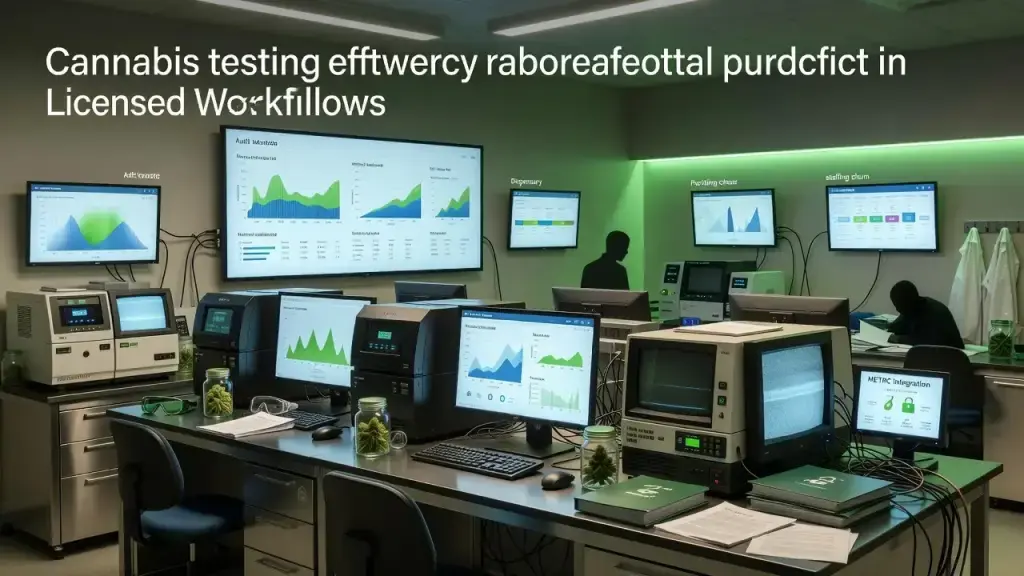
Licensed cannabis testing labs are rethinking how they buy instruments, and the shift has real consequences for the operators who depend on those labs for compliant COAs. A recent purchasing survey of laboratory professionals found that user-friendly software is now rated nearly as important as price when choosing equipment vendors, a change that matters enormously for an industry where lab turnaround times and data integrity already sit under constant regulatory watch.
Why This Matters for Cannabis Testing
Every legal cannabis market runs on third-party lab testing. Potency, pesticide screening, microbial contamination, heavy metals, residual solvents - all of it has to clear a licensed lab before product reaches a dispensary shelf. The instruments doing that work, HPLC and GC-MS systems chief among them, generate the data that regulators, operators, and ultimately consumers rely on. If a lab's chromatography software is clunky, slow to validate, or hard to audit, that friction doesn't stay inside the building. It shows up as delayed COAs, backed-up batches, and wholesale product sitting in a warehouse instead of moving to dispensary shelves.
That's the backdrop that makes the survey findings worth paying attention to. Price/value is still rated very important by most lab buyers, but it's no longer running away with the decision. Software usability has closed the gap, and among lab managers specifically, it has pulled ahead of price entirely.
Staffing Churn and Validation Pressure Look Familiar in Cannabis
Cannabis testing labs know staffing churn intimately. Analytical chemist roles in this sector often see faster turnover than in traditional pharmaceutical or clinical labs, partly because cannabis testing is a younger industry still building its talent pipeline, and partly because pay scales haven't always kept up with the technical demands of the work. When a new analyst has to spend weeks learning an instrument's software before running samples independently, that's lost throughput at a lab that may already be sitting on a backlog of batches awaiting release.
Validation demands compound the problem. Cannabis testing operates under state-specific regulatory frameworks, many of which require documented method validation and defensible audit trails, not unlike the Part 11 electronic-records expectations that pharmaceutical and clinical labs have lived with for years. A chromatography data system that scatters changes across multiple screens makes that kind of audit trail painful to reconstruct. One that consolidates review into a single view makes it defensible. For a lab's compliance officer, that difference isn't cosmetic. It's the gap between passing a state inspection smoothly and scrambling to produce records on request.
What Operators and Brands Should Take From This
Dispensary operators, cultivators, and brands don't buy HPLC systems, but they feel the downstream effects of how well their testing lab's equipment performs. A lab stretched thin by software that slows down data review is a lab more likely to run behind on turnaround times, and turnaround time directly affects how fast a cultivator or processor can move product through seed-to-sale tracking systems like METRC and onto a wholesale menu.
- Slower lab review cycles can delay compliant packaging and labeling finalization, pushing back product launches.
- Audit-trail weaknesses at a testing lab can complicate a state's enforcement review if a COA is ever challenged.
- Connected instruments that touch a lab's network raise cybersecurity questions, the same concern operators already face with POS systems and seed-to-sale integrations.
In practice, though, most operators never see which chromatography software their testing partner runs. What they do see is whether COAs arrive on schedule, whether lab reports hold up to scrutiny, and whether a testing partner can scale as volume grows. Those outcomes trace back, in part, to decisions labs make at the purchasing stage, decisions that increasingly weigh software usability alongside the invoice total.
The Bigger Picture for a Regulated Supply Chain
Cannabis remains a Schedule I substance federally, and testing requirements vary state by state, which means labs are already managing a patchwork of validation standards without the benefit of a single federal framework. Add staffing pressure and tightening data-integrity expectations, and it's not surprising that lab operators are scrutinizing software as closely as price. For an industry still working to convince regulators and the public that its testing infrastructure is reliable, that scrutiny is a reasonable, even necessary, cost of doing business.