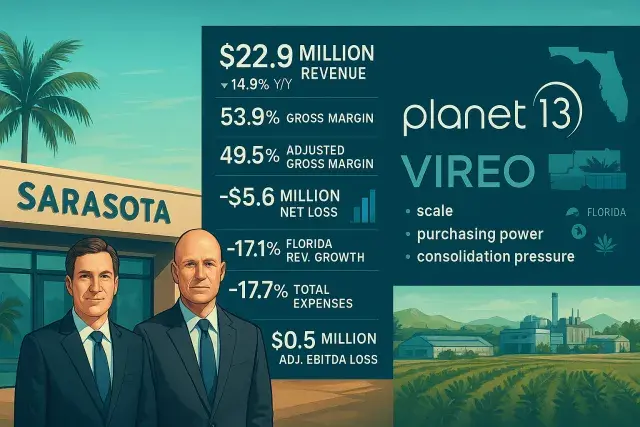
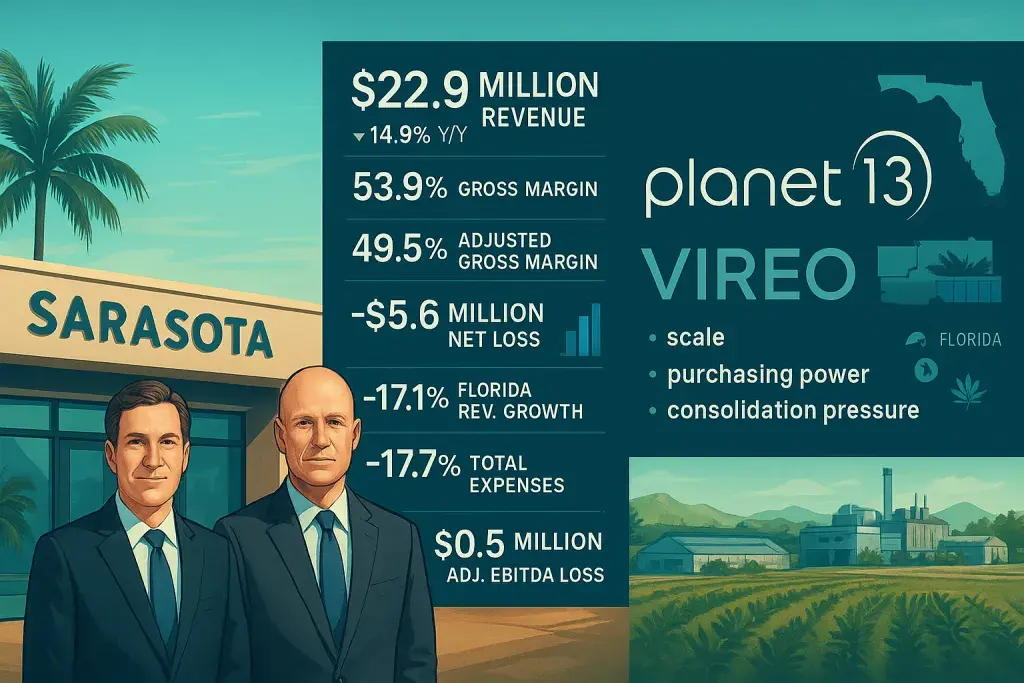
Planet 13 Holdings reported second-quarter revenue of $22.9 million, down 14.9% from a year earlier, as the multi-state operator absorbed the effects of exiting California retail and wholesale operations while continued price compression squeezed sales in Nevada and Florida. The results, released for the period ended June 30, 2026, arrive as the company works toward closing its previously announced merger with Vireo Growth Inc., a deal that will reshape how Planet 13 competes in a market that increasingly rewards scale over standalone footprint.
Margin Gains Mask a Smaller Business
The headline revenue decline tells only part of the story. Gross margin actually improved to 53.9% from 43.4% a year earlier, and even stripping out a one-time $1.0 million reduction in the company's Florida distillate inventory reserve, adjusted gross margin still came in at 49.5%. That's a meaningful jump for an operator that just walked away from an entire state market. The mechanism here is straightforward: California retail and wholesale had become a drag on blended margins, and cutting it loose, combined with company-wide procurement discipline, let the remaining footprint run leaner. Total expenses fell 17.7% to $15.2 million, and the net loss narrowed to $5.6 million from $13.3 million. Adjusted EBITDA loss shrank to $0.5 million from $2.4 million. In practice, though, a smaller, more efficient business is still a smaller business, and the revenue base Planet 13 is now defending has contracted meaningfully.
Florida Momentum Amid a Volatile Market
Florida revenue climbed 17.1% quarter over quarter, a figure Co-CEO Larry Scheffler pointed to as evidence the company has stabilized operations in a state where wholesale pricing has been under pressure for extraction-based products like distillate. The May approval from the Office of Medical Marijuana Use for a BHO extraction facility, along with the planned Sarasota store announced in July, signal continued investment in Florida even as the broader deal with Vireo moves forward. For operators watching Florida's medical market, the inventory reserve adjustment is a useful data point: excess distillate inventory has been a persistent margin drag across the sector, and Planet 13's ability to work that reserve down as sales absorbed supply is the kind of operational detail that matters more to balance sheets than to headlines.
What the Vireo Merger Signals for Multi-State Operators
Co-CEO Bob Groesbeck's comments framed the quarter's results as proof of a functioning platform, but also as the rationale for combining with a larger partner. The logic he laid out - that the market rewards scale, purchasing power, broader distribution, and balance sheets capable of absorbing price compression - reflects a consolidation pressure playing out across regulated cannabis retail generally. Smaller vertically integrated operators, even well-run ones, face structural disadvantages under Section 280E tax treatment, ongoing price compression in mature adult-use and medical markets, and the capital intensity of maintaining cultivation, extraction, and dispensary operations across multiple states. Because of the pending transaction, Planet 13 will not hold its usual earnings call this quarter, a procedural detail but one that underscores how closely tied the company's near-term communications now are to the merger timeline.
Balance Sheet and Operational Watch Points
Cash and restricted cash stood at $16.5 million versus $15.6 million at year-end 2025, while total assets slipped to $144.3 million from $152.3 million and total liabilities rose to $105.5 million from $101.2 million. Those movements are modest, but they matter for any stakeholder assessing how much runway the company has independent of the merger closing. For dispensary operators, suppliers, and landlords watching the multi-state operator sector, the filing offers a case study in how exiting an underperforming market, tightening procurement, and working down excess inventory reserves can improve margin even as top-line revenue contracts - a trade-off increasingly common across licensed cannabis retail as operators prioritize durability over expansion.