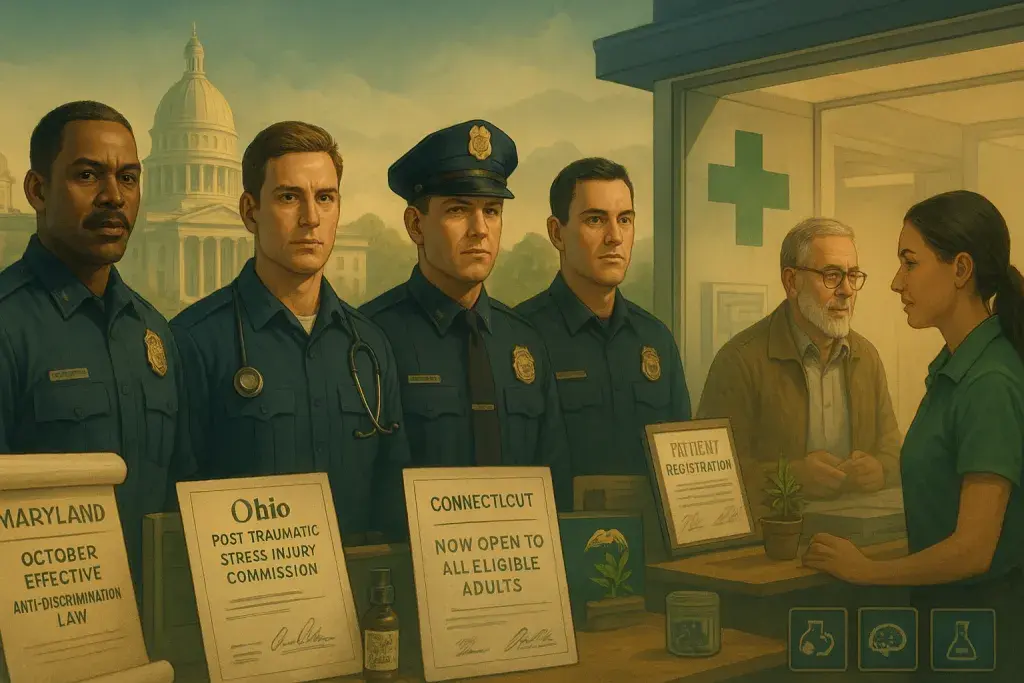
A quiet but consequential shift in state policy is reshaping how first responders can access mental health treatment - and, in some cases, how medical cannabis fits into that picture. Several states enacted or advanced legislation this year that moves beyond standard counseling and prescription medication, extending new legal protections and treatment pathways to firefighters, law enforcement officers, paramedics, and emergency medical workers dealing with post-traumatic stress. For licensed cannabis operators and medical dispensary programs, these developments carry real regulatory and operational weight.
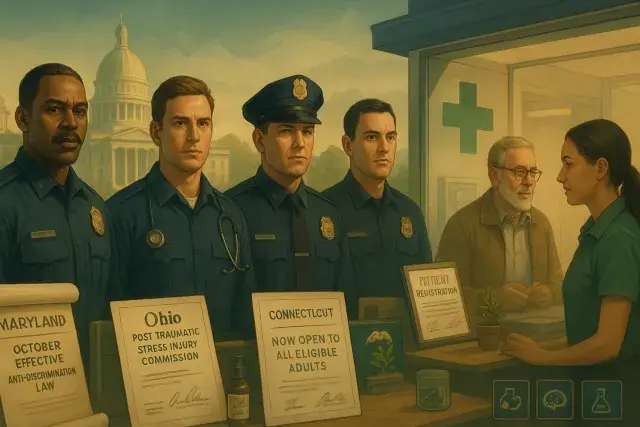
Maryland's approach is the most direct for the cannabis industry. A new state law - effective October - bars employers from discriminating against firefighters, EMTs, paramedics, and other rescue workers who are registered medical cannabis patients and test positive for cannabis metabolites, provided they are not impaired while on duty. That distinction matters enormously. It doesn't legalize on-the-job use; it creates a protected class of off-duty patients. For dispensaries serving Maryland's medical cannabis market, this signals a potential expansion of the registered patient base among first responders who previously faced career risk for enrollment. Operators tracking patient demographics and wholesale demand should pay attention. Medical cannabis compliance programs vary widely by state, so dispensaries expanding into new markets or patient segments would do well to see how it works in tightly regulated adult-use and medical markets before adjusting their intake and documentation workflows.
Ohio took a structurally different route. Republican Gov. Mike DeWine signed legislation creating a Post-Traumatic Stress Injury Commission, which will review applications from eligible first responders seeking financial assistance for treatment costs. The law does not specify cannabis as a covered treatment, but the commission framework is broad enough - and the political symbolism of a Republican governor signing it is notable enough - that it reinforces a wider bipartisan softening around alternative and emerging mental health therapies for public safety workers.
Psychedelics Enter the Policy Conversation
Connecticut and Missouri pushed further into emerging-therapy territory, though neither has crossed into commercial availability. Connecticut expanded a Yale University pilot program studying psilocybin-assisted therapy, opening participation to any state resident 18 or older who meets clinical eligibility criteria established by Yale's institutional review board. Previously, the program was limited to veterans, retired first responders, and frontline health care workers. Missouri's legislature advanced - but did not ultimately pass - a bill that would have allowed veterans and first responders enrolled in approved research studies to receive psilocybin and ibogaine under medical supervision for PTSD and other mental health conditions. The session ended in May before the bill reached the governor's desk.
Here's the thing: psilocybin remains a Schedule I controlled substance under federal law, and ibogaine carries its own significant legal and clinical complexity. These are not products moving through state-licensed cannabis retail channels. But the policy trajectory matters for licensed operators anyway - because the political logic driving these bills is the same logic that has consistently expanded medical cannabis access. When state legislatures vote to protect first responders' right to use medical cannabis off-duty, or fund research into psychedelic-assisted therapy for public safety workers, they are normalizing the premise that conventional pharmacology doesn't have all the answers for this population.
What This Means for Licensed Cannabis Operators
Medical cannabis dispensaries in states with active or growing first-responder patient populations face a few operational realities worth thinking through carefully. Employment protection laws like Maryland's don't automatically produce patient enrollment. Eligible workers still need to know the law applies to them, understand what a medical cannabis card registration requires, and trust that their employer won't find informal workarounds to the new protections. Dispensary patient-education programs and budtender training take on added relevance here - not as a sales function, but as a compliance-adjacent service.
On the compliance side, employment-protection laws introduce a distinction between impairment and metabolite presence that existing drug-testing frameworks weren't designed to handle. Cannabis metabolites can persist in the body for days or weeks after use - long after any psychoactive effect has passed. This is not a new problem for the cannabis industry, but it becomes newly consequential when a state law says "metabolites alone aren't disqualifying." Dispensaries that operate patient consultation programs or work with HR departments in corporate or institutional accounts should understand what that distinction means clinically, because their patients certainly will ask.
Jason Cerrano, a retired Missouri firefighter and paramedic with more than 20 years of experience who now works in commercial research and development at IDEX Fire & Safety, put the underlying dynamic plainly: "When you are in the fire service, or any first responder industry, or especially in the military, stuff builds up over time, and what happens is you see so many things that the crazy stuff starts to at least seem normal." That normalization of trauma - and the inadequacy of one-size-fits-all treatment - is exactly what's driving legislators across party lines to consider a broader range of options.
The Broader Regulatory Signal
None of these state actions create immediate new revenue lines for cannabis retailers. But the policy direction is not ambiguous. States are extending legal legitimacy to medical cannabis use among a population - first responders - that has historically faced institutional pressure to avoid it. Employment discrimination protections remove one of the most tangible barriers to patient enrollment in this demographic. That has downstream implications for patient counts, inventory planning, and, in states where medical and adult-use programs operate on separate licensing tracks, for how operators think about the value of maintaining or expanding medical program participation.
For multi-state operators, watching which additional states follow Maryland's employment-protection model is a reasonable compliance planning exercise for 2025. The policy is replicable, it doesn't require a new licensing infrastructure, and it's the kind of incremental reform that moves through legislatures with less friction than adult-use expansion. In practice, that means the medical cannabis market isn't done growing - not by a long way.