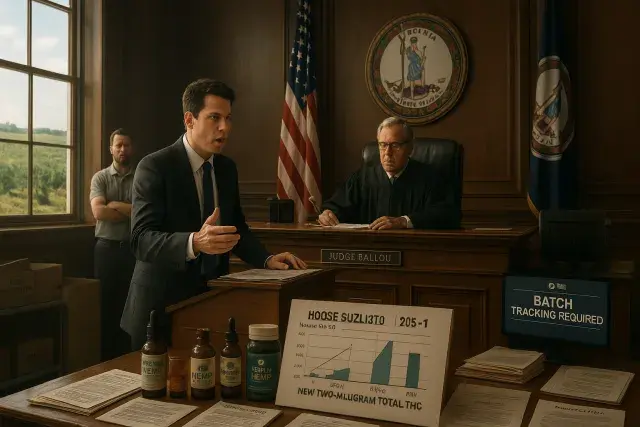
A federal judge in Virginia spent nearly five hours Wednesday weighing whether to pause a set of hemp restrictions before they take effect Aug. 15, and the outcome will determine whether dozens of small retailers can keep selling products that are legal today but could become contraband by the weekend. Seven hemp businesses sued to block enforcement, arguing the state gave them no realistic runway to adjust inventory, packaging, or sourcing before the deadline hits.
The dispute traces back to House Bill 30, folded into Virginia's budget, which eliminates the old 25-to-1 CBD-to-THC ratio exception and caps most hemp products at two milligrams of total THC per package. That's a dramatic tightening compared to what operators built their businesses around, and it lands with almost no transition period. For multi-state operators and independent shops alike, the episode is a reminder of how fast a regulatory floor can shift underneath a compliant supply chain - the kind of volatility that makes reliable back-office infrastructure, whether that's inventory reconciliation, batch tracking, or a Metrc-compliant POS for Oklahoma-style system built for shifting state rules, worth its cost long before a crisis hits. Metrc-compliant POS for Oklahoma
What the New Limit Actually Changes
Under the prior framework, products with a favorable CBD-to-THC ratio could carry more total THC and still qualify as legal hemp. The new two-milligram-per-package ceiling removes that flexibility almost entirely, meaning a wide swath of tinctures, beverages, edibles, and vape products currently on store shelves would no longer meet the state's definition of hemp once the law takes effect. Products don't become safer or less safe overnight - they simply become illegal to sell, which is a distinction that matters legally but not physically.
That mismatch is central to the plaintiffs' argument. Attorney Chap Petersen framed the timeline as unworkable: the governor didn't sign the bill until June 29, leaving businesses roughly six weeks to liquidate, reformulate, or destroy inventory tied to crops planted back in April. Hemp is agricultural. You can't relocate a harvest the way you might move a piece of equipment across a state line. Once a crop is grown and processed for the Virginia market, Petersen argued, it has nowhere else to go.
The Compliance Cliff Facing Retailers
Store owners describe a scenario familiar to anyone who has managed compliant retail inventory through a sudden rule change: product sitting on a shelf, fully legal one night, potentially criminal to sell the next morning. Cody Moorefield, who owns Simply Hemp in Collinsville, testified that his business could be holding stock that flips from lawful to unlawful at midnight with no mechanism to sell it off, return it, or destroy it in an orderly way. That's not a labeling problem. It's an existential inventory-management problem, and it's one no POS system or compliance log was built to solve because the law itself doesn't address what happens to legacy stock.
Petersen also raised a takings claim, arguing the state may be stripping value from businesses that invested under one set of rules only to have those rules rewritten with little notice. He was careful to note the plaintiffs aren't asking the court to strike the law outright - just to pause enforcement while a broader constitutional case proceeds, potentially into next year.
Why This Matters Beyond Virginia
Virginia's move fits a broader pattern: states building out regulated adult-use marijuana markets are simultaneously moving to rein in intoxicating hemp products that have operated in a looser gray zone. For operators, wholesalers, and brands watching from other states, the lesson isn't really about Virginia's specific THC threshold. It's about how little notice a legislature can give before flipping a compliant product into a controlled substance overnight. Retailers who treat regulatory monitoring as a background task, rather than a core operating function, are the ones most exposed when a budget rider rewrites the rules with six weeks' warning.
Whatever Judge Ballou decides, the case underscores a growing tension in hemp regulation nationally - between agricultural realities, small-business survival, and a policy environment still catching up to a product category that expanded faster than most states' rulebooks anticipated.