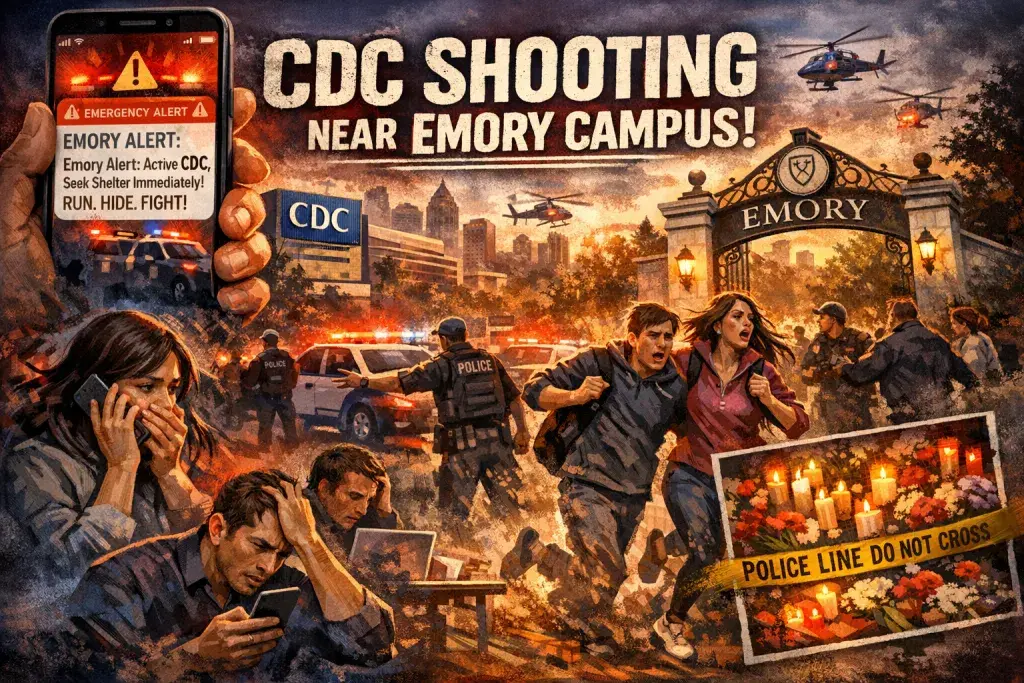
At 5:02 p.m. on a Friday, Emory University students across the country received urgent alerts about an active shooter at the Emory Point CVS near the Atlanta campus, prompting immediate calls to run, hide, or fight. The warning, tied to a fatal shooting at the adjacent Centers for Disease Control and Prevention headquarters, locked down the university and drew national attention to a community shattered by sudden violence. Proximity to these institutions amplified the terror, as students and alumni processed a breach in what many viewed as a secure academic haven.
Instant Alerts Fracture Sense of Security
Phones buzzed with garbled texts and official notifications, blending confusion with raw fear. Emory student Michael Lee, in class at the time, recalled the disbelief: “I couldn’t believe it. I immediately thought of my friends on campus.” Senior Sarah Watson, living off-campus near the CDC, witnessed runners and sirens firsthand, heightening the immediacy. Such alerts, standard in active shooter protocols, underscore how digital warnings now bridge distances, pulling remote community members into real-time crises. This mechanism, refined after mass shootings like Virginia Tech in 2007, aims to save lives but often sows widespread anxiety before facts emerge.
Proximity to CDC Deepens Community Trauma
The incident struck at Emory’s core, mere blocks from the CDC headquarters where DeKalb County police officer David Rose, 33, fell. Alumni like Emily Chen in San Francisco fixated on updates, mourning the loss of a “safe, bubble-wrapped campus.” CDC employees among the alumni faced personal stakes, with Chen noting friends enduring the ordeal. Junior David Kim captured the limbo: uncertainty blurred campus boundaries, forcing shelter-in-place amid unclear threats. These responses reflect broader patterns in urban-academic zones, where research hubs neighbor public spaces vulnerable to spillover violence.
Collective Response Forges Resilience Amid Grief
Group chats surged with safety tips and check-ins, as Watson observed: “We were all just trying to look out for each other.” Post-incident, the university activated counseling and vigils near a memorial on Clifton Road, where mourners laid flowers in tears. Lee emphasized unity: “It’s going to take time to heal, but we’re all in this together.” Such solidarity mirrors reactions to campus tragedies nationwide, revealing how tight-knit groups process violation through shared mourning and support. Yet the event exposes persistent risks in sanctuary-like settings, prompting questions on bolstering perimeter security without eroding open inquiry.
Broader Echoes in Academic Sanctuaries
Emory’s renown for academic rigor now contends with this stark reminder of vulnerability. Shootings near educational institutions, from universities to federal sites, erode presumptions of isolation, fueling debates on alert efficacy and mental health resources. The community’s path forward hinges on processing collective shock while reinforcing safeguards, a challenge familiar to schools navigating America’s gun violence landscape. Healing demands time, but mutual reliance offers a foundation against fragility.