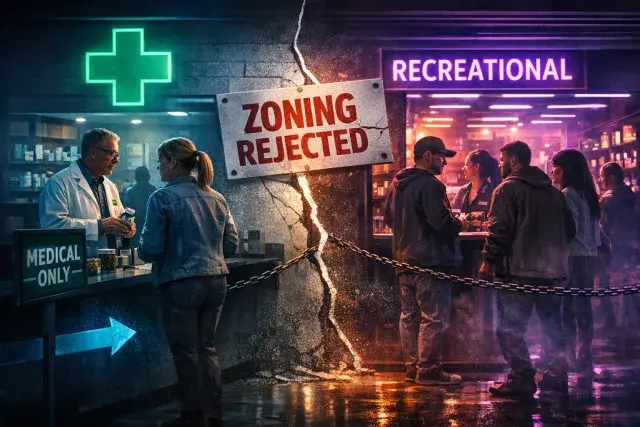

On December 18, 2025, President Trump signed Executive Order 14067, directing federal agencies to begin the process of reclassifying cannabis from Schedule I to Schedule III under the Controlled Substances Act. For cannabis businesses operating legally under state law, the order's most immediate consequence isn't regulatory - it's financial. The potential elimination of Section 280E of the Internal Revenue Code as an applicable tax burden could fundamentally alter the economics of an industry that has spent years doing business with one hand tied behind its back.
The 280E Problem, Explained
To understand why rescheduling matters so much to cannabis operators, you have to understand what Section 280E actually does. The provision bars any business engaged in "trafficking" Schedule I or II controlled substances from deducting ordinary and necessary business expenses on its federal return. Rent. Payroll. Utilities. Marketing. Legal fees. Every cost that a normal business deducts as a matter of course - cannabis companies cannot. Because Schedule III substances fall entirely outside 280E's reach, a completed reclassification would, in one stroke, subject cannabis businesses to the same federal tax treatment as any other lawful enterprise.
The thing is, cannabis operators haven't been entirely without recourse. Under current law, cost of goods sold - the direct costs of producing or acquiring inventory - is treated as an offset to gross income rather than a deduction, placing it outside 280E's reach. Cultivation labor, raw materials, packaging: these can be capitalized into inventory under Section 263A and recovered when goods are sold. Savvy operators have leaned heavily on this distinction, maximizing what gets capitalized to reduce taxable income. But the strategy has a ceiling. Section 263A(a)(2) restricts those capitalization rules for businesses with average annual gross receipts exceeding $25 million, which means larger multi-state operators - precisely the companies that face the largest absolute tax bills - get the least benefit from the workaround.
What remains is an effective tax rate that, in many cases, bears no resemblance to statutory rates. Retail operators especially have felt this; dispensaries carry high overhead by nature, and when rent and payroll are nondeductible, margins compress to the point where some operations become economically untenable. Rescheduling wouldn't just lower taxes - for a meaningful segment of the industry, it could be the difference between viability and closure.
What the Rulemaking Process Actually Looks Like
Here's the catch: the Executive Order directs rescheduling. It doesn't accomplish it. The Attorney General must engage the Drug Enforcement Administration and the Department of Health and Human Services in formal rulemaking - either through an expedited process or the standard notice-and-comment procedure, which can extend over years. Both pathways are expected to draw litigation. Industry participants should plan accordingly: no one should be restructuring their balance sheet on the assumption that 280E relief arrives next quarter.
The rescheduling rationale rests on state-authorized medical cannabis programs that have demonstrated therapeutic efficacy for conditions including chronic pain and anorexia - credible evidence that satisfies the "accepted medical use" standard required for Schedule III classification. That scientific foundation is substantive, not performative. But the administrative record still needs to be built, noticed, and defended. Barring legal challenge, an expedited process might conclude in six months or more; traditional rulemaking could take considerably longer.
On timing of tax relief specifically: the Executive Order establishes no binding deadline for completion. Whether the IRS would allow 280E relief to apply retroactively to the beginning of the tax year in which reclassification becomes final remains an open question - a favorable one, but entirely unresolved absent explicit administrative guidance. Prudent operators should file their 2025 federal returns under the existing 280E framework and consult tax advisors on projected liabilities and contingency planning for subsequent periods.
Recreational Operators Shouldn't Expect a Federal Green Light
Schedule III status does not create a federal pathway for recreational adult-use cannabis sales. That bears repeating, because conflating tax reform with federal legalization is an easy mistake - and a costly one for operators who make business decisions based on it. State regulatory frameworks remain unchanged. Distribution of Schedule III substances stays confined to FDA-approved drugs and state-regulated programs; recreational commerce would remain a state-law matter, not a federally sanctioned one.
The banking picture improves only at the margins. Smaller state-chartered institutions may find reduced compliance friction in extending deposit services to cannabis clients, but access to traditional capital markets, mainstream payment processors, and federal trademark registration will remain constrained. Anti-money-laundering obligations under the Bank Secrecy Act don't evaporate with a scheduling change, though practical enforcement against state-compliant operators is unlikely to intensify. The structural isolation of cannabis from the mainstream financial system - the thing that has driven operators to cash-intensive models for years - persists.
What rescheduling does move, in a meaningful way, is research. Schedule I classification has historically imposed significant barriers on scientific study; Schedule III opens the door considerably. Organizations working at the intersection of healthcare, clinical research, and cannabis stand to gain access to a less encumbered research environment. That has long-tail implications for product development, regulatory approval, and the eventual normalization of cannabis therapeutics - but it plays out over years, not months.
Preparing Now, Before the Rules Are Written
The practical advice for operators is straightforward, even if the regulatory timeline isn't: use the interval between executive order and final rulemaking to do the planning that a normalized tax environment would demand. Entity classification choices - LLC, S corporation, C corporation - carry substantially different implications when ordinary business deductions are actually available. A structure optimized for the 280E world may not be optimal post-rescheduling; the analysis is worth running now, not after the rule is finalized.
Rescheduling solves the tax problem and reduces research barriers. It doesn't solve banking, interstate commerce, or federal legalization. Those are separate legislative problems that an executive order cannot touch. Cannabis operators who absorb that distinction clearly - and plan around it - will be far better positioned than those waiting for a comprehensive federal resolution that, at present, has no clear path forward.