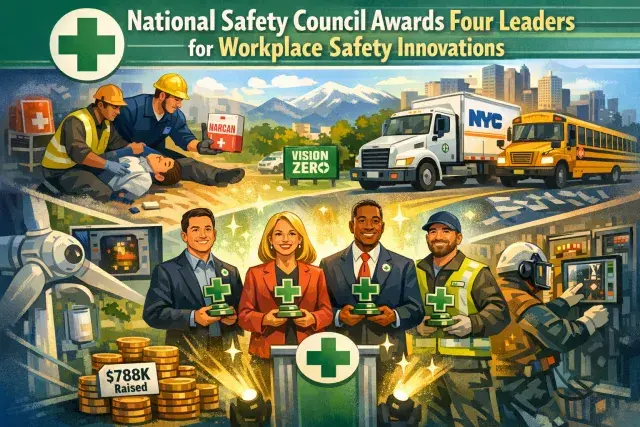
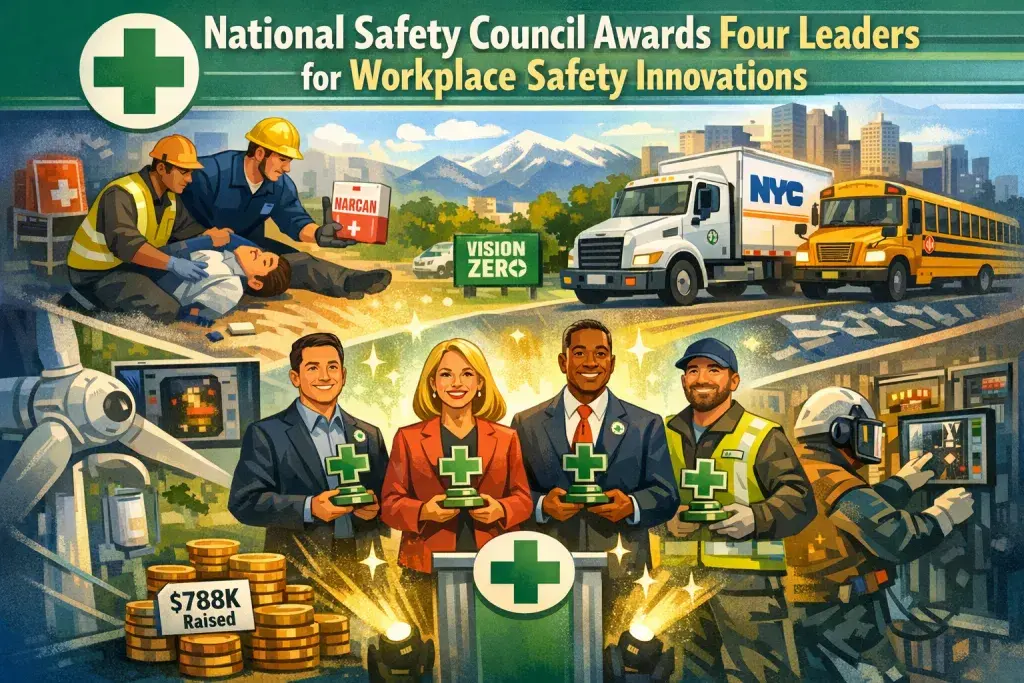
The National Safety Council presented its Green Cross for Safety Awards to four organizations in Denver on Tuesday, recognizing standout efforts in safety advocacy, excellence, and innovation during the 26th annual celebration sponsored by U.S. Steel. These honors highlight practical steps companies and agencies take to protect workers amid persistent hazards like opioid overdoses, traffic crashes, and industrial risks. The event also raised over $788,000 to support broader workplace health initiatives.
Advocates Tackle Opioid Crisis in Workplaces
Amazon and Emergent BioSolutions received the Safety Advocate Award, sponsored by First Student, for expanding access to naloxone, the overdose-reversal drug, across job sites. Amazon stocks this medication in its North American facilities, responding to calls from public health officials and nonprofits during a crisis that claims hundreds of thousands of lives annually in the United States. Emergent, producer of NARCAN Nasal Spray, educates businesses—from construction sites to airlines—on preparing for accidental exposures, mirroring the routine presence of automated external defibrillators in many workplaces.
These efforts address a gap in emergency preparedness. Opioid overdoses often strike suddenly in professional settings, where delayed response can prove fatal. By normalizing naloxone alongside other first-aid tools, the winners model how employers can save lives without waiting for regulatory mandates.
Fleet Safety Sets Municipal Standard
The New York City Department of Citywide Administrative Services earned the Safety Excellence Award, sponsored by Amazon, for managing the nation's largest municipal fleet of over 28,500 vehicles plus a 10,000-bus school fleet. Since 2017, its Safe Fleet Transition Plan enforces technologies like intelligent speed assistance, truck sideguards, and telematics to curb crashes under the Vision Zero initiative, which New York pioneered in 2014. Updated in 2019 and 2023, the plan has delivered more than 100,000 safety upgrades in partnership with the U.S. Department of Transportation's Volpe Center.
Vision Zero aims to eliminate traffic deaths through engineering and enforcement, a principle now adopted by dozens of U.S. cities. DCAS demonstrates how scale amplifies impact: retrofitting vast fleets reduces collisions for drivers, pedestrians, and first responders alike, offering a blueprint for other municipalities facing rising urban traffic risks.
Remote Tech Minimizes Industrial Hazards
Puget Sound Energy claimed the Safety Innovation Award, sponsored by Centuri, for installing SYTIS TC-90 cameras inside wind turbine nacelles and electrical enclosures. These tools allow remote diagnosis of heat and electrical faults, slashing the need for hazardous climbs and early detection of fire risks like arc blasts. Success in turbines led to field deployment for converter troubleshooting, accelerating repairs while prioritizing technician safety.
Renewable energy growth exposes workers to high-altitude and high-voltage dangers. PSE's approach underscores a shift toward predictive maintenance in utilities, where visual monitoring prevents outages and injuries, aligning with industry pushes for safer clean energy infrastructure.
Broader Push for Enduring Safety Gains
NSC CEO Lorraine M. Martin praised the winners for efforts that safeguard workplaces and communities long-term. Their strategies connect to national trends: opioid preparedness counters a public health emergency, fleet tech advances road safety amid urbanization, and remote diagnostics support expanding renewables. Such leadership influences peers, fostering cultures where safety integrates into operations, potentially averting countless incidents.