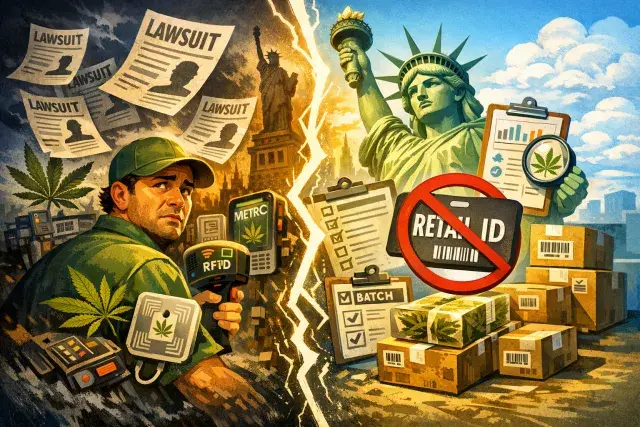
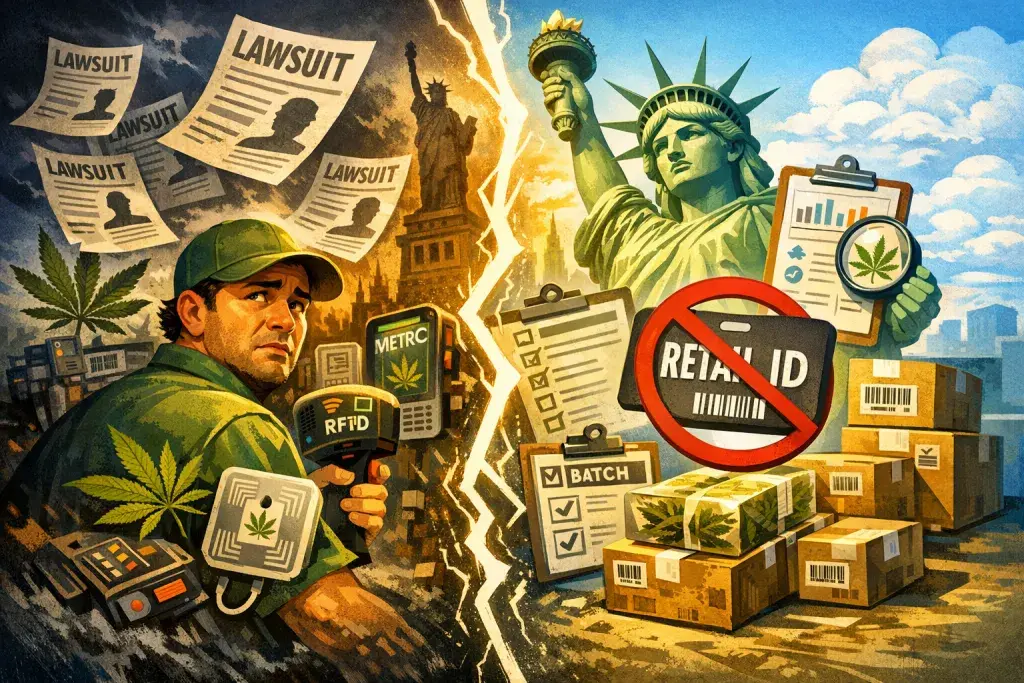
New York cannabis operators worry a lawsuit against Metrc's Retail ID program will dismantle track-and-trace systems and revive last year's inventory chaos. This fear grips the industry amid ongoing compliance struggles. In reality, Retail ID serves as a financing tool, not the foundation of tracking, and its removal would preserve core safeguards while easing burdens on small businesses.
From BioTrack to Metrc: A Contract Mismatch Emerges
New York's original seed-to-sale system relied on BioTrack, which tracked cannabis at the lot and batch level using fully digital identifiers. BioTrack charged $0.10 per digital identifier for lots, batches, and packages—a cost-recovery fee to sustain operations, not a profit mechanism. When BioTrack left the market, Metrc acquired the contract but inherited rigid constraints: a $0.10 cap on digital fees, limits on physical tag markups, and no state funding for system maintenance.
Metrc introduced physical RFID tagging, absent under BioTrack, which spiked costs and logistics for operators. The fixed pricing made the contract economically unviable without changes. Retail ID emerged as Metrc's solution: a unit-level serialization that reinterprets "lot" and "batch" to apply the $0.10 fee to millions of individual retail units, subsidizing physical tags and turning the fee into the contract's main revenue source.
Track-and-Trace Stands Independent of Retail ID
Effective tracking hinges on batch integrity, package custody, transfer manifests, physical segregation, and audits—methods that function in every mature cannabis market, including New York's pre-Retail ID era. Last year's inversions and inventory failures stemmed from system transition glitches, naming errors, and vendor rollout issues, not the absence of unit-level tags. Retail ID arrived after these problems and adds no unique recall power.
Recalls target batches defined by shared inputs, production time, conditions, or contamination risks. Unit-level data fragments these batches into millions of records, complicating reassembly during crises. Without Retail ID, New York could still pinpoint affected batches, trace shipments, locate dispensaries, and execute recalls more swiftly through batch-level systems proven elsewhere.
The Hidden Labor Toll and Small Business Squeeze
Beyond fees, Retail ID imposes massive labor costs: more scans, error risks, reconciliations, training, and audits. This setup advantages large operators with automation, conveyor systems, and robotics while overwhelming craft producers and small businesses—precisely the operators New York legalization aimed to empower. New York serves as Metrc's mandatory test bed for a product resisted nationally and unproven at scale.
Operators fund this through per-unit payments, uncompensated labor, and data generation that refines Metrc's tools. This model extracts value from licensees without ownership or opt-out rights, resembling private infrastructure over public utility.
Lawsuit Challenges Economics, Not Safety
The lawsuit targets how Retail ID forces operators to cover Metrc's contract shortfalls via fees and labor, not track-and-trace itself. Public safety remains secure through batch tracking. New York should fund its regulatory systems transparently, as other states do, but even a cost-free Retail ID would harm small operators via labor demands.
Two paths lie ahead: retain Retail ID and accelerate industry consolidation, or eliminate it to sustain batch tracking, cut labor, and shield smaller players. Operators can learn more or join at [email protected]. More than 20 have committed; facts dispel fear.